
ESG asks how you treat people today. It has no language for whether your operating model keeps them economically visible tomorrow. Two governance gaps nobody owns, and five questions every board should be asking
The question ESG can’t ask
Environmental, social and governance (ESG) reporting asks a reasonable question about people: how are you treating them today? Pay gaps, wellbeing, training hours, diversity. Useful numbers, properly reported.
It has no language at all for a question that is about to matter far more. Does the way you are combining human and digital labour keep people economically visible tomorrow?
Most boards would struggle to answer it. Not because they don’t care, but because nobody has ever asked them to.
That isn’t a philosophical question. Earlier in this series we looked at what happens when output keeps growing and taxpayers disappear, and at the employment law that can’t see work once it moves to a system. Both of those land, eventually, on the board.
And right now, inside most organisations, the two governance gaps underneath them belong to nobody.
Gap one: who owns captured capability
Start with the Digital Me.
A Digital Me is capability captured, structured and deployed beyond a person’s presence: their knowledge, judgement and way of working, running in a digital system. Earlier in the series I described this as the point where capability stops behaving like labour and starts behaving like an asset.
Assets have owners. So who owns this one?
At the moment, intellectual property (IP) law defaults to the firm. If it was built at work, from work, it is probably yours. Commercially convenient. Legally untested. Ethically questionable.
Think about what that means in practice. Someone spends ten years becoming the person everyone calls when the difficult case lands. Their judgement gets captured in a twin. They leave. The twin stays, still doing the work and still creating value, and they take nothing with them.
Ownership also decides what happens next. If the person owns their twin, it can travel with them like a pension: licensed to an employer while they work there, paid for by them between jobs, and taken with them when they go. If the firm owns it, the person’s most valuable asset stays behind every time they move.
My own view is that people should create and own their Digital Me, and license it to their employer while they work there. Some of the loudest voices in our industry argue the opposite: that employers should own twins of their colleagues’ expertise. I think that is the wrong answer, and I think it will age badly.
But whichever side you are on, the point stands. Ownership needs to be settled in contracts and governance now. If it is settled in litigation later, it will be settled by someone else, at your expense.
Gap two: governing digital workers as workforce
The second gap is the digital workforce itself.
If Artificial Intelligence (AI) agents plan and carry out work across your organisation, they are not tools in your technology stack. They are members of your workforce. They take decisions, touch customers and produce outcomes that somebody will be held accountable for.
Which raises an awkward question. What would you expect of any other worker doing that job?
You would expect performance standards: what good looks like, and how you know when it is slipping. You would expect bias audits, especially anywhere near hiring, pay or customer decisions. You would expect an audit trail, so you can reconstruct what happened and why. And you would expect a named human accountable for every automated decision.
Almost nobody has all four. Most organisations can’t say who is accountable when an agent gets it wrong, because the agent was bought by information technology (IT), configured by a vendor, used by operations and owned by no one.
That isn’t a technology problem. It is a workforce governance problem, and workforce governance is Human Resources’ (HR’s) job.
None of this needs new technology. Most of it is the discipline you already apply to people: a job, a manager, a review and a record. The difference is that agents don’t complain when nobody is managing them, so the gap stays invisible until something goes wrong.
Workforce sustainability as the fourth pillar
So here is the frame that makes both gaps legible to a board.
ESG already asks boards to think about environmental impact over decades, about social impact, and about the quality of their own governance. What it doesn’t ask is whether the organisation’s operating model keeps people economically visible over the lifetime the board is supposed to steward.
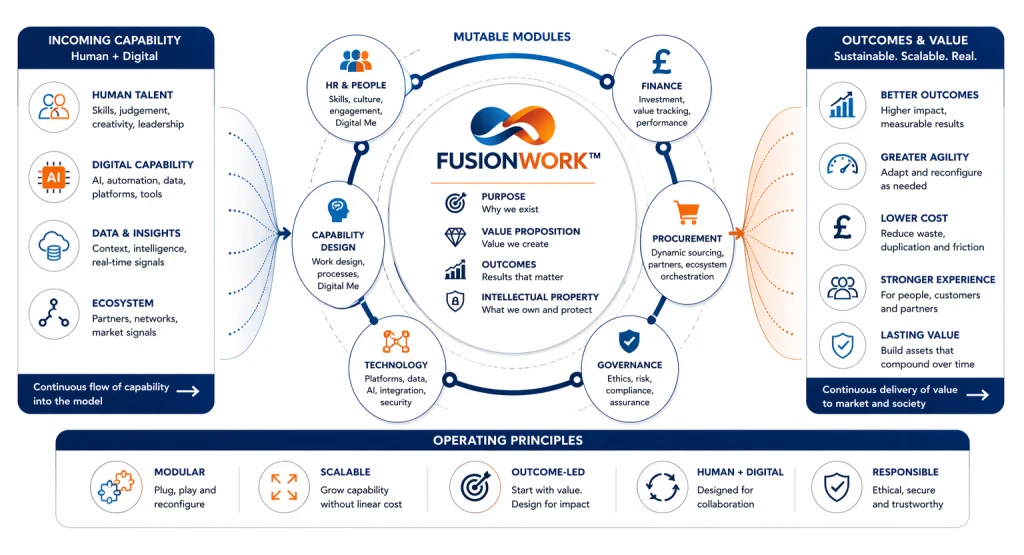
That is workforce sustainability, and it belongs alongside the other three as a fourth pillar. The FusionWork™ white paper puts it as a principle:
“Treat the fusion of human and digital labour as a governance question: does your operating model keep people economically visible over a fifteen-year horizon?”
The horizon matters. This isn’t “are we treating people well this year?” It is a fifteen-year question. Will the people who carry your capability today still be able to earn from it? Will there be a pipeline of people learning the work, or just agents doing it? Will your customers still have wages to spend?
None of those are soft questions. They are the same kind of long-horizon risk a board already accepts when it talks about climate. The only difference is that nobody has put them on the agenda yet.
There is a commercial argument too. Investors already ask how exposed a business is to the transition to net zero. It is not a stretch to expect the same question about the transition to digital labour: how much of your margin depends on removing people, and how long can that last?
What a board should be asking
If you are a Chief People Officer (CPO), here are five questions to put on the next board agenda.
1. Who owns the capability we capture from our people, and have we settled that in contracts, or are we waiting for a test case?
2. Which digital workers are running in this organisation today, and who is accountable for each of them?
3. Do our AI agents have performance standards, bias audits and audit trails, the same as any other worker in a comparable role?
4. Which entry-level roles are we removing, and where will our future managers learn the work?
5. Over fifteen years, does our operating model keep people economically visible, or does it just make them cheaper to remove?
These are not questions HR can answer alone. Ownership needs legal. Accountability for agents needs IT and operations. The fifteen-year view needs finance. But HR is the function that should be asking them, because every one of them is, at heart, a question about the workforce.
If the honest answer to most of these is “we’re not sure”, you have found the gap. And you have found it before a regulator, a tribunal or a journalist found it for you.
ESG asks how you treat people today. Workforce sustainability asks whether your operating model keeps them economically visible tomorrow. Boards need to be able to answer both.
If you want to help shape the governance models we are building with organisations and policymakers, join the FusionWork™ research programme.
This is the eighth article in a series drawn from the Bloor Research white paper FusionWork™: Defining a New Category of Work. The first asked why approximately 90% of job descriptions no longer describe the job. The sixth looked at where UK employment law breaks when work moves to a digital system.
Cheney Hamilton
Research Director – FusionWork™ Bloor Research
Print Article for this blog Download here