


One third right work, one third wrong work, one third invisible — and why the third that creates the most value is the one your automation decisions cannot see
Ask any senior manager what they actually did last week.
Not what their job description says they do. What they actually did.
Roughly a third of it will be the work they were hired for.
Roughly a third will be work they were pulled into and should never have been doing.
And roughly a third will appear in no document, no system and no performance review — and it is usually the third that made the real difference.
Now ask the question that matters for anyone deploying Artificial Intelligence (AI).
Which third are you automating?
Where the thirds come from
Between October 2024 and December 2025, Bloor Research conducted structured research with more than 500 Human Resources (HR) Directors and Chief Financial Officers (CFOs) across UK financial services, technology, housing, retail and the public sector.
One finding from that work has already been widely discussed: approximately 90% of people have a job description that does not reflect what they actually do.
The framework that emerged underneath that finding has had rather less attention. I think it is the more useful of the two, particularly if you are a Chief Operating Officer (COO) trying to work out where your capacity is actually going.
We call it the Thirds Model.
Right work. Wrong work. Invisible work.
Right work is roughly a third of capacity. Strategic decisions. Problem solving. Relationship building. Innovation. Value creation. It is visible, measurable and high impact. It is the work the role was designed to deliver.
Wrong work is roughly another third. Duplicate activity. Manual administration. Rework. Chasing approvals. Low-value tasks. It consumes capacity without creating value — and almost nobody’s job description mentions any of it.
Invisible work is the final third. Informal coaching. Workarounds. Knowledge sharing. Stakeholder management. Change navigation. It is frequently critical and it is almost never measured.
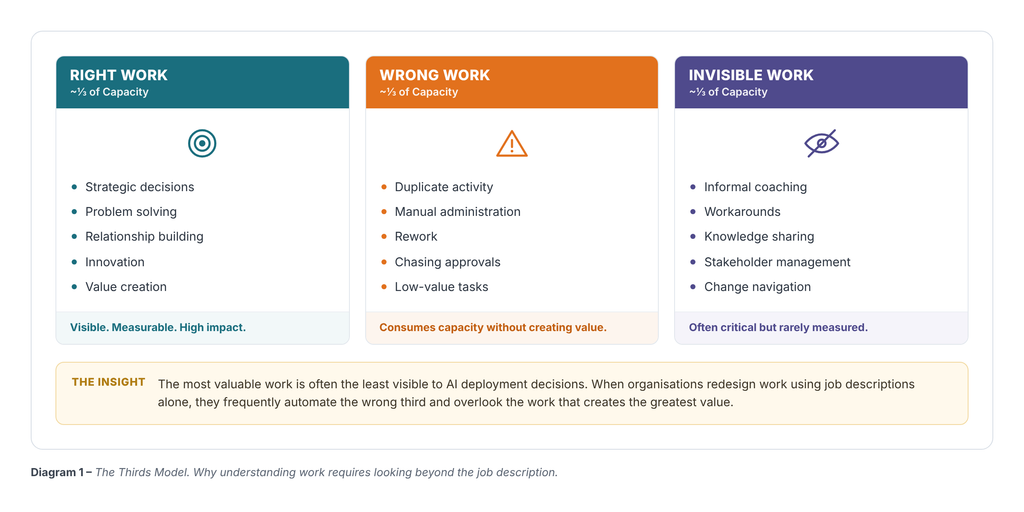
[Supplied as a separate attachment. Caption: The Thirds Model. Why understanding work requires looking beyond the job description.]
Read those three descriptions again and notice something.
Only the first third is written down.
The invisible third is usually the valuable third
This is the part that tends to stop people mid-sentence.
The invisible third is not administrative residue. It is high-impact, cross-functional, frequently innovative contribution. And it is almost never captured in a job description.
It is the senior engineer who quietly mentors four juniors without any of it appearing in a development plan.
It is the operations manager who knows which supplier will flex on a deadline and which will not, because of a relationship built over nine years.
It is the person everyone rings when the process breaks, who is named nowhere in the process documentation.
You usually find out what that third was worth when the person carrying it leaves.
Not before.
What role-based automation gets wrong
Now put two facts side by side.
AI deployment decisions are made from job descriptions, because job descriptions are the most readily available description of what people do. They are already written, and they carry the authority of something formal.
But job descriptions capture the first third reasonably well, the second third barely at all, and the third third not in the slightest.
So role-based automation is optimised for the one third that was already visible, and blind to the third that creates the most value.
It gets worse. The wrong third — the genuine capacity drain, the duplicate activity and the rework — is also invisible to a role-based analysis, because nobody’s job description says “chase approvals” or “redo the report because two systems disagree”.
Which means the one third of capacity you could most safely and profitably remove is the third your map does not show you.
Harvard research on task-level automation exposure makes the same point from a different direction: exposure is distributed at the level of tasks, not job titles.
That is precisely why a map drawn at the level of roles produces the wrong automation decisions — and why it produces them confidently.
The most valuable work is often the least visible to AI deployment decisions. When organisations redesign work using job descriptions alone, they frequently automate the wrong third and overlook the work that creates the greatest value.
How to find your thirds
None of this is an argument for guesswork or for another engagement survey.
What the research points towards is a systematic mapping of work at the level of outcomes rather than roles. We call it a Workforce X-Ray.
Unlike a traditional job evaluation exercise, it maps what work is actually being performed — by humans and by digital systems — across an organisation’s value chain. It identifies where human and digital contribution are already fused without formal recognition. It surfaces the thirds.
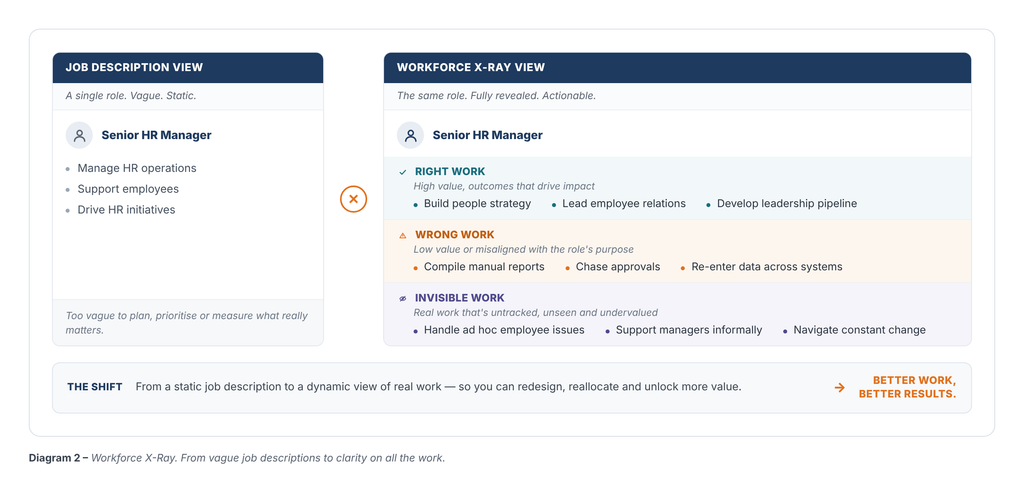
[ Supplied as a separate attachment. Caption: Workforce X-Ray. From vague job descriptions to clarity on all the work.]
Take a single role — say, a Senior HR Manager. The job description view gives you three or four bullets: manage HR operations, support employees, drive HR initiatives. Too vague to prioritise against, and certainly too vague to automate against.
The Workforce X-Ray view of the same role separates the right work (building people strategy, leading employee relations, developing leadership pipeline), the wrong work (compiling manual reports, chasing approvals, re-entering data across systems), and the invisible work (handling ad hoc employee issues, supporting managers informally, navigating constant change).
Same person. Same week. Completely different basis for a decision.
Organisations that have undertaken this process report that mapping work at outcome level, even in a single function, immediately surfaces misalignment, duplication and hidden value that was previously invisible.
That clarity is itself a form of risk reduction. It is also the prerequisite for any AI adoption strategy that is designed rather than defaulted into.
Start with one function
You do not need an enterprise programme to test any of this.
Take one function. Map it at outcome level rather than role level. Find your thirds.
I would predict three things. You will find more wrong work than you expected. You will find invisible work that nobody has ever accounted for and that your organisation quietly depends on. And you will find that at least one of your planned automation targets was aimed at the wrong third entirely.
That is a better week’s work than most transformation programmes manage in a quarter.
If you would like to see your own thirds, we are running Workforce X-Ray pilots in single functions — designed to surface outcome-level work and quantify the hidden capacity inside it. If your organisation is ready to look honestly at what work is actually being done, I’d like to talk to you.
This is the second article in a series drawn from the Bloor Research white paper FusionWork™: Defining a New Category of Work. The first asked why approximately 90% of job descriptions no longer describe the job.

1 Comment