
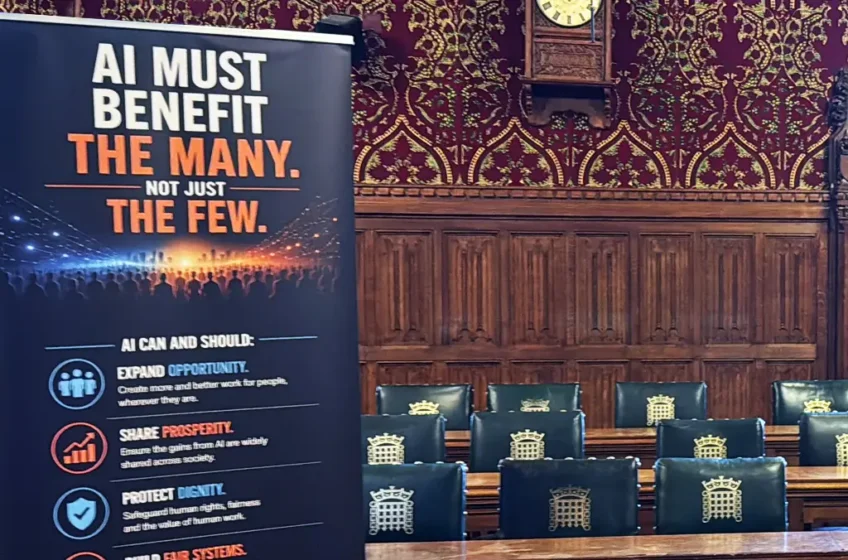
Last month, Bloor Research was at Westminster to put a single question to MPs and their teams: when a person’s job is taken not by another company but by a digital worker, who protects them?
Under TUPE, when work transfers between employers, the people move with it and their rights are preserved. It’s one of the settled foundations of UK employment law – but it was written for a world in which work passes between human hands. When a role is displaced by automation or an agentic AI system, none of that protection applies. The person doesn’t transfer. They fall outside the frame entirely, because the law still treats AI as a tool rather than as a form of labour.
This is a gap, not a decision. No one debated it. And it’s a question Parliament is now beginning to ask directly – whether existing workplace protections still hold as AI reshapes the workforce.
The MPs we spoke to grasped it quickly. One was especially struck by the fiscal dimension: a human worker generates income tax and National Insurance; a digital “twin” doing the same work generates neither. Productivity rises while the tax base quietly erodes – a gap that compounds as adoption accelerates.
That’s why Bloor is now supporting a proposed All-Party Parliamentary Group on the evolution of work in a fusion economy – to give this question a permanent home in Parliament, alongside our ongoing engagement with MPs on TUPE reform. The technology is moving fast. The protections have to move with it.
The person doesn’t transfer. They fall outside the frame entirely – because the law still treats AI as a tool, not as labour