

We Have Never Actually Paid for Time
Employment law, pay structures and the entire four-day week debate rest on one assumption – and Artificial Intelligence has just made it redundant
Here is a sentence that sounds wrong and is not.
We have never actually paid for time.
Every flexibility argument ever made assumes that we do. So does the four-day week debate. So does employment law. So do compensation structures, job evaluation, performance management and very nearly every workforce policy written in the last century.
All of it rests on the assumption that time is the unit of value.
It never was.
What we were actually buying
We have always paid for capability.
For how people think. How they decide. How they create. How they solve the problems nobody wrote down in advance.
Time was simply the most convenient proxy available for measuring it.
And for a long while it was a reasonable one. If capability could only be delivered by a person, in a place, during hours when that person was physically present, then counting the hours was a serviceable way of counting the capability. Not precise. But close enough to build a system on.
So we built everything on it.
We built employment contracts around hours. We built pay structures around time served and grades attained. We built performance management around what could be observed during the working day. And we built an entire legal and fiscal architecture – Pay As You Earn (PAYE), working time regulations, holiday entitlement, redundancy calculation – on the assumption that value flows from human labour, delivered within defined roles, over measured time.
The proxy became so deeply embedded that we stopped being able to see that it was a proxy at all.
Why the proxy is breaking now
Artificial Intelligence (AI) is not replacing time.
It is making the proxy redundant.
Capability can now be deployed independently of time. A person’s knowledge, judgement and decision-making can operate through digital systems without their physical presence, without their working hours, and without the constraints of any employment relationship at all.
Once that becomes possible, the old proxy does not simply become less accurate.
It becomes actively harmful.
Because it means organisations are rewarding the wrong thing, measuring the wrong thing, and optimising an entire system of work around something that was never the real source of value in the first place.
This is, I think, the most under-discussed shift in the current conversation about AI. We are debating whether machines will take jobs. The more consequential question is what happens to a hundred years of institutional design when the thing it was all built to measure stops being the thing that matters.
Three ways capability creates value
FusionWork™ does not change what has always been true about value creation. It makes it visible. And once it is visible, three distinct ways that capability generates value come into focus.
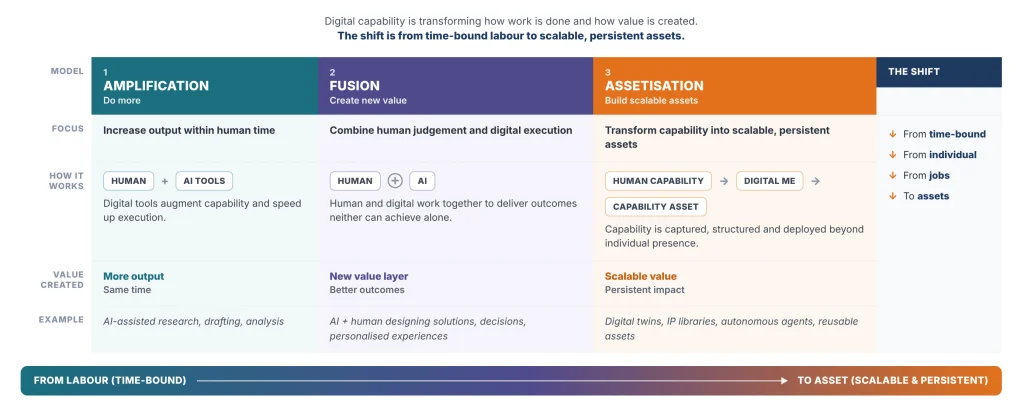
One: Amplification
Capability deployed faster, at greater scale, within the same unit of time.
This is where almost all current AI investment sits. The human does what the human did before, but assisted – research that took a day takes an hour, a first draft arrives in minutes, analysis that needed a team needs a person.
It is genuinely valuable. It is also the most limited of the three, because the unit of value has not changed. You are still buying time. You are simply getting more out of each unit of it.
Amplification has a ceiling, and most organisations are approaching it faster than they expected.
Two: Fusion
Human capability and digital execution combined to create outcomes that neither could deliver independently.
This is the layer most organisations have not reached, and it is qualitatively different from amplification. It is not a person working faster. It is a person and a system producing something that neither would have produced alone – a decision informed by pattern recognition across a volume of data no human could hold, shaped by judgement no system possesses.
Consider a lending decision. The system surfaces patterns across a hundred thousand comparable cases. The human reads the things the data cannot hold – that this business has just changed hands, that the sector is turning, that the last three years were atypical for reasons that will not recur. Neither party reaches the right answer alone. The outcome belongs to the combination.
The value generated here is not proportional to the hours worked by either the human or the machine.
Which is precisely the point at which paying for time stops making sense as a model.
Three: Assetisation
And then there is the one that changes the category entirely.
Once an individual’s capability is captured and structured in digital form – increasingly described as a Digital Me – it takes on the characteristics of an asset.
Unlike labour, which is time-bound and transient, a capability asset is persistent, scalable and deployable across contexts. It does not stop when the person goes home. It does not halt during parental leave. It can be deployed in two places at once.
This is the point at which the existing frameworks begin to break down, because none of them was built for a world in which individual capability can operate as an independent economic entity.
Employment law assumes a person. Intellectual property law assumes a creator. Taxation assumes income flowing to a human within an employment relationship. Compensation design assumes a unit of contribution that can be observed and bounded.
A capability asset satisfies none of those assumptions.
And it raises a question that most organisations have not begun to answer:
who owns it?
Intellectual property law currently defaults ownership of captured capability to the firm. That is commercially convenient. It is also legally untested and, I would argue, ethically questionable. If a Digital Me is trained on an individual’s accumulated knowledge, judgement and professional experience, the claim that it belongs wholly to whichever organisation happened to employ them at the time is not self-evidently correct.
That question deserves an article of its own, and it will get one later in this series.
What this means for how you reward people
If you accept the argument, the implications for reward are uncomfortable.
Job evaluation methodologies score roles. Pay structures reward time served and grade attained. Performance frameworks measure what happened during working hours.
None of those instruments can see amplification, fusion or assetisation. They are calibrated to a unit of value that is quietly ceasing to be the unit of value.
There are three questions worth putting on the table now, before the gap widens further.
What proportion of the value your organisation creates is already being generated outside measured hours? If a capability asset keeps producing after the person who built it has moved on, what exactly were they paid for? And when two people deliver the same outcome, one in forty hours and one in four, which of them does your pay structure currently reward?
Most organisations cannot answer the first question, have not considered the second, and will not like the answer to the third.
I am not going to pretend there is a finished answer to any of this. There is not, and anyone offering one is selling something. But the organisations that start asking now – what are we actually paying for, and can we see it? – will be considerably better placed than those still refining their job evaluation matrix in 2030.
The four-day week debate asks whether we should buy fewer hours.
It is the wrong question, asked about the wrong unit.
The better question is whether we should be buying hours at all.
The full argument – including the FusionWork™ architecture, the fiscal modelling, and the research behind it – is set out in the Bloor Research white paper FusionWork™: Defining a New Category of Work. You can download it here.