
Your AI programme probably isn’t failing because of the technology. It’s failing because you’ve pointed it at a map of your organisation that’s about 90% fiction.
Why isn’t AI delivering ROI for HR?
Ask an HR Director how their AI programme is going and you’ll get one of two answers.
The official version: pilots running, use cases scoped, “really encouraging early signs”.
Then there’s the version you get after the second coffee. The tech is in. The money’s spent. The board wants to know where the returns are. There aren’t any yet.
I hear the second version a lot. What gets me is that almost everyone who tells it thinks they’re the only one. Surely some other organisation out there has cracked it.
I’ve looked. They haven’t.
Because nobody admits it, nobody compares notes. So everyone does the same thing on their own and blames the tool. New vendor. Bigger model. Another six-month pilot. More money thrown at the one part of the programme that was never broken.
The real problem is far less glamorous. It’s the job description.
What did the research find about job descriptions?
Between October 2024 and December 2025, Bloor Research spoke to more than 500 HR Directors and CFOs across UK financial services, technology, housing, retail and the public sector.
Having both in the sample matters. HR writes the description of the work. Finance pays for it. If the map was only wrong on one side, you’d hope the other side would notice.
Neither did.
And it didn’t matter where we looked. Sector, size, seniority, digital maturity. Same answer every time.
Around 90% of people have a job description that doesn’t reflect what they actually do.
(Bloor Research, 500+ HR Directors and CFOs, October 2024 to December 2025)
I’d be amazed if that surprised you. Most job descriptions were written by someone who has since left, for a role that has since changed, on a template nobody has opened since the last restructure. People pick up bits of a colleague’s job when that colleague leaves. New systems change how the work gets done. Nobody updates the paperwork, because nobody ever updates the paperwork.
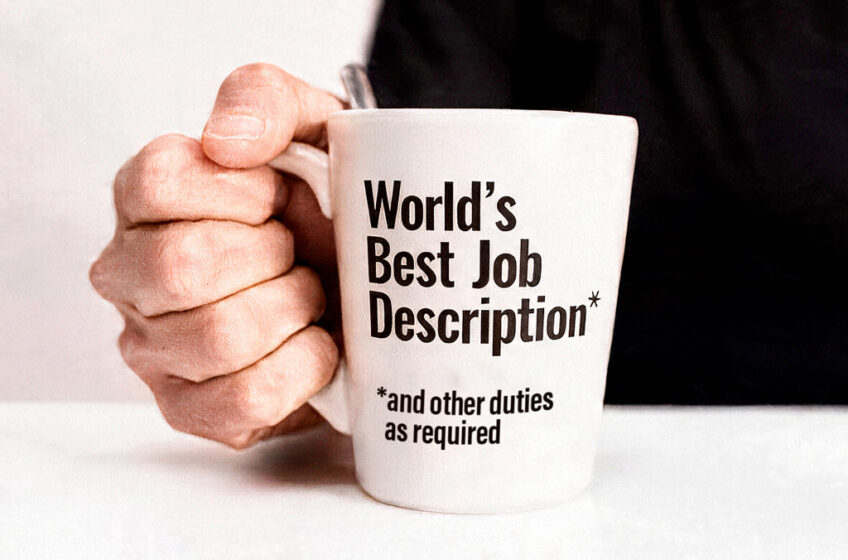
If your own job description ends with “and other duties as required”, you already know which line describes your actual week.
None of this is anyone being lazy. Put a fixed document inside an organisation that never stops changing and it was always going to go stale.
So the 90% isn’t the headline. The consistency is. This isn’t a handful of badly run organisations. It’s how organisations describe work, full stop.
Which would be mildly embarrassing and not much more, if we weren’t now using those documents to make some very big decisions.
Why do outdated job descriptions matter for AI deployment?
Plenty of people treat job descriptions as recruitment admin. Write it, post the advert, file it, forget it.
I wish. In reality a surprising amount rests on that one document.
- Pay and grading. Job evaluation starts from what the role is said to involve.
- Performance. Objectives and reviews point back to it.
- Redundancy. When roles are pooled or removed, the job description is the evidence.
- AI. It increasingly decides which tasks get automated, which roles get augmented and which functions get restructured.
That last one is the one that should worry you.
When a job description was only used for pay and grading, being wrong was annoying. A decent manager could see the gap and work around it. Feed the same document into an automation decision and there’s no decent manager in the middle. The mistake goes straight into the design, at scale.
An example. Take an operations coordinator. Their job description says scheduling, reporting and supplier liaison. On paper, lovely, most of that could be automated by Friday. In real life, a big chunk of their week goes on catching errors before customers see them, training new starters because nobody else has time, and keeping two systems talking that were never designed to meet.
Automate the job description and you’ve automated the scheduling. You’ve also got rid of the safety net, and you won’t find out until something falls through it.
So pay, performance, redundancy and now automation are all being decided from a map of an organisation that no longer exists.
Workforce planning takes the same hit. Headcount model, skills framework, automation roadmap: if they all start from the job description, they’re all wrong in exactly the same way. They’ll agree with each other beautifully. That’s what makes it so hard to spot.
Is AI in HR making this worse or better?
Worse, for now. Not because the technology is bad, but because it’s very, very good at doing exactly what it’s told.
AI is not a tool. It is a force multiplier. If you automate clarity, you scale value. If you automate ambiguity, you scale risk.
Older systems got away with messy inputs because people sat around them. Someone would look at the output, say “that’s not how we do it here” and fix it by hand. AI removes that friction. That’s the whole selling point. It also removes the person who would have spotted the problem.
Automate a process you understand and you get faster, cheaper and more consistent. Automate one you’ve only written down and you get your mistakes faster, cheaper and more consistently. Congratulations.
You can already see this in most organisations. Where the official process doesn’t work, people build their own workarounds, and more and more of them are using their own AI tools to do it.
So I don’t think organisations are bad at AI. I think they’re being asked to use it before anyone has done the groundwork that makes it usable.
And there isn’t much time. The World Economic Forum’s mid-2026 Chief People Officers’ Outlook found that 83% of organisations expect to be scaling AI within the next six to twelve months. Most will scale it on the same wrong map. AI adoption is about to run straight into the mapping problem, and it’ll happen in this planning cycle, not the next one.
Is this the same as writing better job descriptions?
Please, no.
I can see the project plan already. Rewrite every job description in the organisation. Twelve months, a steering group, a shiny new template. By the time you finish, the first batch is out of date again.
A better job description is still a job description. It still describes a role, and it’ll drift for the same reasons, on the same timeline, as the one it replaced.
The real shift is from roles to outcomes.
Stop asking “what does this job description say this person does?” Start asking “what is this work actually producing, and who or what is best placed to produce it?”
That’s a completely different piece of analysis. A role describes inputs: a person, a list of duties, some hours. An outcome describes what the organisation needs. Design around outcomes and you can make a proper decision about what people do, what AI does and what they do together. Design around roles and you inherit whatever the last restructure left behind.
Back to our operations coordinator. A role-based view asks which of their listed duties a system could take over. An outcome-based view asks what the team needs: orders right first time, new starters up to speed, suppliers paid on time. Some of that AI should absolutely do. Some of it needs judgement and relationships no system is going to replicate. And some of it shouldn’t be happening at all. You only get those three answers once you stop staring at the role.
What should HR Directors and COOs do on Monday?
Don’t try to fix every job description at once. You’ll still be at it in 2028.
Pick one function, ideally one that’s already on the AI roadmap. Customer operations, finance shared services and HR itself are all good places to start.
Map it by outcome, not by role. What’s actually happening, who’s doing it and what it produces. Talk to the people doing the work, not just their managers, because managers tend to describe the org chart rather than the Tuesday.
Then lay that map next to the job descriptions for the same team and see what doesn’t match.
You’ll find work nobody knew was being done. Work being done twice. Work sitting with the wrong person because they said yes in a meeting once and never managed to give it back. In most teams it breaks down roughly into thirds, and only one of those thirds is written down anywhere.
That gap is your evidence. It’s usually the first thing a board will accept as proof that the AI strategy needs to change, not just the tech. It also gives HR and Finance something they rarely get: the same picture of the work to plan against.
And get HR and operations in the room together. HR owns the map. The COO owns the outcomes. Neither of you can fix this alone, however tempting it is to try.
The technology is ready. Your map probably isn’t. Start there.
Print Article for this blog Download here

1 Comment