
Digital workers add to Gross Domestic Product. They pay no income tax, no National Insurance, and they never go shopping. Why that gap belongs in your business case, not just the Treasury’s
For most of economic history, output and employment travelled together.
Not perfectly. There was the odd recession, and the occasional industrial revolution, to shake things up. But they moved closely enough that Gross Domestic Product (GDP) worked as a reasonable shorthand for how a country’s people were doing. When output grew, more people were working, earning, paying tax and spending what they earned.
That relationship is coming apart, and you can see exactly where.
A digital worker generates output. It processes the claim, reconciles the account, answers the customer and drafts the report. All of that is counted in GDP.
It does not pay income tax. It does not pay National Insurance (NI). And it does not buy anything, so it generates no Value Added Tax (VAT) either.
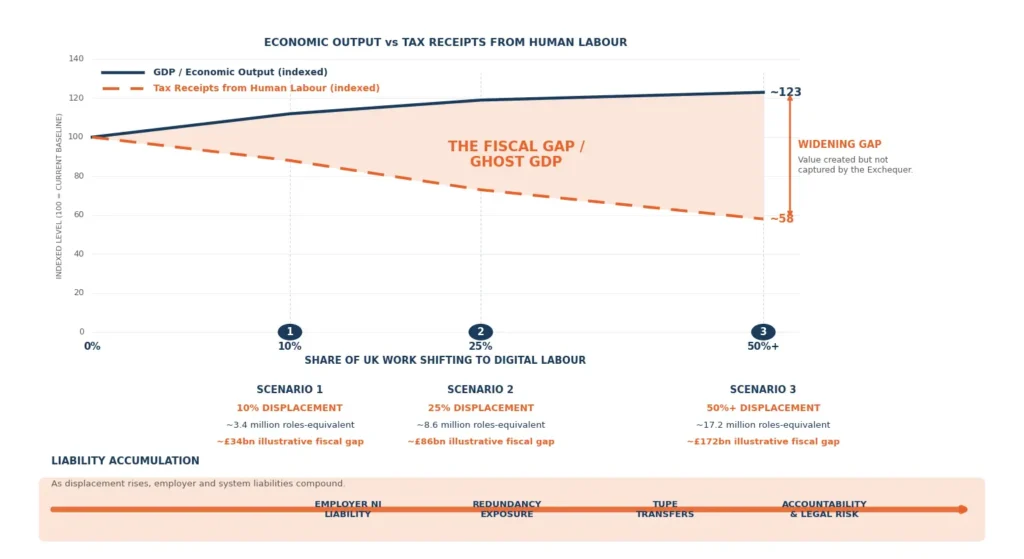
I call the output that sits in that gap Ghost GDP. It is real value, properly counted, that no longer carries the receipts we have always assumed came attached to it.
What Ghost GDP means
Every major system that funds UK public life rests on one assumption: value flows from human labour, delivered within an employment relationship, over measured time.
Pay As You Earn (PAYE) collects on it. NI is built on it. VAT depends on people having wages to spend. Public services, pensions and the welfare system all sit downstream of that one flow.
Digital labour breaks the assumption without breaking the output. That is what makes it so easy to miss.
When a factory closes, everyone notices. The jobs go, the output goes, and the headlines arrive on the same day.
When work moves to digital labour, the output carries on. The service still runs. The month-end still closes. Productivity may even improve, so the numbers that get reported look like good news.
What disappears is the part nobody reports on: the person who used to be paid to do that work, and the tax, the NI and the spending that came with them. GDP goes up. The tax base goes down. And the dashboard that measures one does not show the other.
The scale of the exposure
So how big could this get?
Section 06 of the FusionWork™ white paper sets out three scenarios. I want to be clear about what they are before I show you the numbers, because this is the part most likely to be lifted out of context.
These are illustrative scenarios, not forecasts. They do not predict what will happen. They show the order of magnitude at stake if work shifts to digital labour and the people displaced are not redeployed. They rest on a single stated assumption: around £10,000 of direct income tax plus employee NI per average displaced role, applied to a UK employment base of 34.4 million (Office for National Statistics (ONS), January to March 2026).
On that basis, if 10% of UK work shifted to digital labour without redeployment, that is around 3.4 million roles’ worth of earning capacity, and roughly £34 billion a year in income tax and employee NI foregone.
At 25%, it is around 8.6 million roles’ worth, and roughly £86 billion a year.
At 50%, it is around 17.2 million roles’ worth, and roughly £172 billion a year.
Those figures are deliberately narrow in what they count. They leave out employer NI, VAT, and the knock-on loss of demand when millions of people have less to spend. Each of those would push the illustrative figures up, not down.
Look at that last scenario again. At 50%, that is on the order of 17 million lost taxpayers, not 17 million lost jobs. The distinction matters. Plenty of those people may still be doing something. What has changed is whether the value they create still passes through a payslip.
This isn’t hypothetical
It would be comforting to file all of this under “one for the 2030s”. The direction of travel says otherwise.
ONS figures published in October 2026 put UK job vacancies at 691,000 in the three months to September, a 12-year low and the latest step in a multi-year decline. Alongside that, around nine million people aged 16 to 64 are economically inactive.
Fewer vacancies means fewer places for displaced people to land. A large inactive population means the system is already supporting millions of people outside paid work.
Then there is the engine that has always got us out of this before. When technology automated one kind of work, new businesses appeared and created new kinds. That engine has been weakening for years. UK business dynamism has been falling, and exiting businesses have been destroying more jobs than new entrants create.
So the old reassurance, that new work always turns up to replace the old, is being tested at the exact moment digital labour is scaling.
The scenarios are illustrative. The direction is not.
Why this is a boardroom issue, not a Treasury issue
This is usually where someone says: “Fascinating, Cheney, but tax receipts are the Chancellor’s problem. I have a business case to get signed.”
I’d push back on that, for two reasons.
The first is demand. If your customers are the same people whose earning capacity is being displaced, the consumption loop runs straight through your revenue line. Your efficiency saving is somebody else’s lost wage, and in a lot of sectors that somebody else is also your customer. That is why the consumption loop belongs in the Chief Financial Officer’s (CFO’s) Return on Investment (ROI) calculation, not in an economics seminar.
The second is reform. A gap of this size does not stay unfilled. No government watches tens of billions of pounds of receipts drift away and does nothing. Whatever closes the gap, whether that is a levy, a change to NI or something nobody has proposed yet, is likely to land on employers inside the planning horizon you are building your business case on right now. The next article in this series looks at what that reform could look like.
Which is why the Chief Operating Officer (COO) needs to raise this before the business case is signed, not after. A case that counts the savings and ignores the liability is not a business case. It is half of one.
Quantify before you deploy
You don’t need to model the UK economy to act on this. You need to model your own exposure.
Before the next Artificial Intelligence (AI) deployment goes to the board, ask three questions. How many roles’ worth of earning capacity does this change? What happens to those people: redeployed, reskilled, or released? And if the rules on digital labour changed within the life of this investment, would the case still stand?
If nobody in the room can answer the second question, you have found your Ghost GDP.
Digital workers generate GDP but pay no income tax, National Insurance or VAT. The fiscal gap is not a forecast to debate. It is a liability to design around.
The full fiscal modelling, including every assumption behind these scenarios, is set out in the Bloor Research white paper FusionWork™: Defining a New Category of Work. You can download it here. This is the fifth article in a series drawn from that paper. The first asked why approximately 90% of job descriptions no longer describe the job. The fourth looked at the undocumented human work propping up reported AI gains.
Cheney Hamilton
Research Director – FusionWork™Bloor Research
Print Article for this blog Download here