

Let’s be honest. The gap between business and IT isn’t a technology problem. It’s a translation problem.
For years, business leaders have talked in outcomes: growth, efficiency, experience. IT teams have responded in systems, architectures, and delivery plans. Somewhere between those two worlds, intent gets diluted into requirements documents, user stories, and ticket queues.
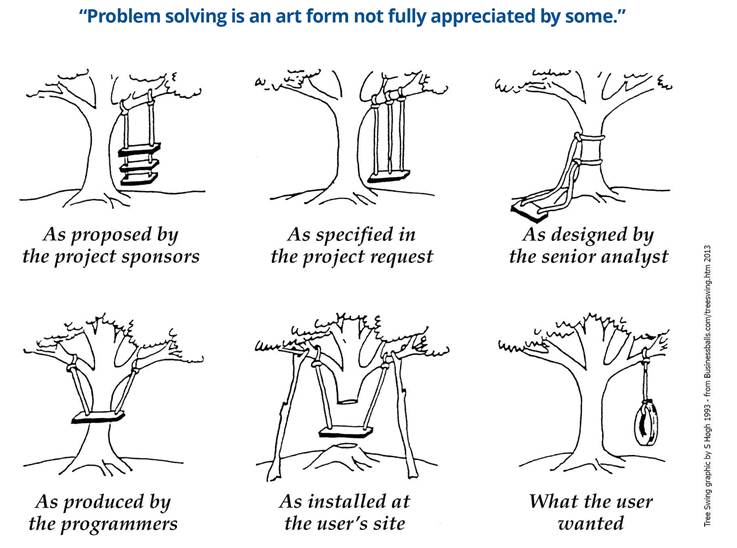
By the time an application reaches production, it often reflects a compromise of interpretations rather than the original business vision, amusingly depicted in this 1993 version of a cartoon that has been around in a variety of forms for as long as I have been in IT (43 years!)
Generative AI gives us a chance to reset that model. Not because it writes code faster — although it does. But because it enables something more fundamental: intent-based app development.
From Requirements to Intent
Traditional development starts with specifications. Pages of them. Intent-based development starts with a simple question: What are you trying to achieve? With GenAI, business users can describe goals in natural language: for example- “Build an onboarding app that collects documents, routes approvals, and keeps customers informed.” From this statement, AI can propose workflows, data structures, UI layouts, and even working prototypes. The system doesn’t wait for perfect requirements. It infers, suggests, and iterates… Intent becomes the primary input.
That’s a profound shift. Instead of spending weeks translating business needs into technical artifacts, teams can move straight into collaborative exploration. Ideas become tangible in minutes. Assumptions surface early. Gaps reveal themselves naturally. The conversation changes from “Is this what you meant?” to “Let’s refine this together.”
A New Relationship Between Business and IT
GenAI quietly flips the power dynamic. Business users are no longer passive requesters. They become active participants in design. They can experiment with flows, test scenarios, and validate concepts without waiting for development cycles.
At the same time, IT teams receive far more structured starting points: generated user journeys, draft APIs, data models, and code scaffolding — all derived directly from business intent. Developers spend less time interpreting ambiguity and more time doing what only they can do: engineering resilient architectures, securing platforms, and integrating systems at scale.
This isn’t about replacing IT. It’s about elevating it.
From Handoffs to Shared Ownership
The real value of GenAI isn’t automation. It’s alignment.
For decades, enterprises have operated on a handoff model: business defines, IT delivers. It sounds simple, but all those hand-offs embed misunderstandings and lead the development further and further away from the original intent. GenAI enables a collaborative model where both sides work simultaneously, using AI as a common language.
Rapid prototyping accelerates learning and teams can validate ideas with real users before major investment. Feedback loops tighten. Strategy becomes tangible. Instead of building first and discovering later, organisations can learn first and build with confidence. That’s how digital transformation should work.
We’re not quite there yet
Of course, GenAI isn’t magic. It is good at handling interpretation and reasoning. But execution demands deterministic systems. Enterprise applications still require governance, compliance, security, and human judgment. AI-generated outputs need review. Production systems still demand professional engineering discipline…and people.
Much of the investigation and early deployment of Intent Based Development really still sits inside the IT domain. Low code platforms like Outsystems, with its Mentor co-pilot are starting to deliver GenAI functionality into the development process. GitHub ran a Workspace Pilot project that gained a lot of plaudits, but they closed the pilot last year because “The techniques that made GitHub Copilot’s completions feel great — low latency, the amodality of ghost text — don’t work when you scale up the size of suggestions from short snippets to entire diffs.” That language itself is evidence that we’re not there yet.
But once the use by business users of GenAI gains traction it will dramatically shorten the distance between intent and implementation. And that’s the point. The opportunity isn’t just faster app development. It’s a new operating model. One where business vision flows directly into execution. Where conversations replace documentation, and where intent drives outcomes.
After years of living with the business–IT divide, GenAI may finally give enterprises a bridge, not made of code, but of shared understanding.
Print Article for this blog Download here
