
Every major company now has a sustainability strategy.
Carbon. Climate. Energy. Recycling. Governance. Social value.
But there is one form of sustainability almost every FTSE 100 and Fortune 500 company is ignoring:
The earning capacity of their customer base.
It sounds obvious. But right now, it’s the most overlooked economic risk of the decade.
Because as companies race to implement AI “efficiencies”, they are cutting the one thing that sustains their entire operating model:
The earning capacity of their customer base.
And this isn’t a theoretical risk, it’s already happening.
A Lesson From Henry Ford That We’ve Completely Forgotten
(and why this matters now)
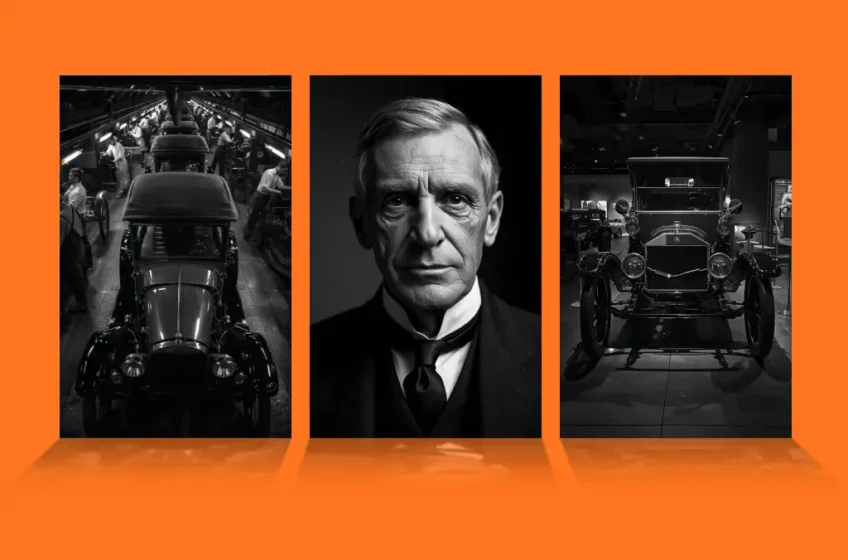
Henry Ford didn’t redesign work for the industrial age out of kindness. He redesigned it to save the economy and to save his own enterprise.
He understood something today’s AI-first executives have forgotten:
Work design is consumption design.
As Peter Watt highlights in On the Transcendental Origins of Henry Ford’s Fordism, Ford created an entire labour-consumption loop :
- Pay workers enough
- Ensure they have predictable hours
- Provide stability
- And create a consumer base strong enough to buy the products they produced.
It wasn’t just industrial engineering. It was economic architecture.
And here’s the crucial insight from Watt’s analysis:
Fordism wasn’t simply technical – it was ideological.
It shaped society by shaping work.
We are now doing the opposite.
We are dismantling the labour-consumption loop at machine speed, without replacing it with anything that can sustain the economy.
The New Paradox of Efficiency
Here’s the modern version :
A consumer buys Amazon products every week. AI optimisation arrives. Their job is automated out of existence. They lose their income. They stop buying Amazon.
Amazon has automated away its own customer.
Multiply that scenario across millions of people, and you can see the truth:
We are entering a period of corporate self-harm.
Businesses are automating production faster than the economy can sustain consumption.
That isn’t innovation. It’s economic contraction disguised as progress.
Henry Ford designed work to expand the market. We’re now designing work in a way that destroys it.
Sustainability Leaders Are Missing the Most Important Sustainability Crisis
Right now, sustainability teams focus on :
- Net Zero
- Waste reduction
- Circularity
- Supply chain ethics
- Carbon reporting
- Land and resource use
All important.
But none of it matters if the underlying economy loses the human income that keeps it functioning.
There is no sustainable business model without Workforce Sustainability; the long-term viability of human earning power and economic participation.
AI threatens that directly.
Yet not a single ESG framework currently measures it.
And Then There’s the Energy Problem No One Wants to Confront
AI is consuming staggering amounts of energy :
- Data centres requiring the power of small countries
- Corporate AI models draining more electricity than aviation fleets
- Cooling demands that outpace renewable capacity
So companies are :
Shrinking their customer base while Expanding their energy footprint
…and still calling it sustainability.
This is the definition of a system failure.
AI Is Not a Tool… It’s a System Reset
This is the most dangerous misconception in business.
AI is not a hammer. It doesn’t behave like a tool.
AI behaves like a force multiplier for whatever system it touches.
If that system is outdated; like job descriptions, workforce structures, performance models, pay frameworks, then AI accelerates the dysfunction.
It eats tasks. It hollows out middle incomes. It removes the work that pays the wages that keep the economy alive.
Without redesign, AI doesn’t just change work. It changes society.
And not for the better.
We Must Do What Ford Did, But For the Age of AI
Ford designed work intentionally for the industrial age and his logic is precisely why the 20th-century economy grew.
We must now do the same for the AI age.
But the new logic is different:
**AI should deliver the outputs.
Humans must deliver the outcomes.**
This is the only viable division of labour going forward.
Because:
- AI is exceptional at task execution
- AI is terrible at judgement and accountability
- AI cannot ethically govern itself
- AI cannot understand nuance, context, or consequence
- AI cannot lead or inspire
- AI cannot own an outcome
- Humans do all of the above.
- And we preserve that contribution only if we redesign work around outcomes, not tasks.
Outcome-based work design gives us :
✔ Clarity on what AI should automate
✔ Clarity on what must remain human
✔ A blueprint for future skills
✔ A reduction in wasted energy
✔ A sustainable labour–productivity model
✔ A protected customer base
This is the only way to build an economy that can survive AI; let alone thrive with it.
Workforce Sustainability: The Missing Pillar of ESG
Here is a simple truth :
- You cannot run a sustainable business if your customers have no income.
- You cannot claim climate progress while scaling energy-hungry AI without redesigning work.
- You cannot replace half your workforce and expect your market to keep spending.
We now need a fourth pillar of ESG:
Workforce Sustainability
A formal strategy to protect earning capacity, redesign work and stabilise demand.
Without it, sustainability reports are theatre.
This Is Exactly Why FusionWork™ Exists
FusionWork is not HR optimisation. It is economic stabilisation. It:
- Redesigns work for the age of AI
- Protects the labour–consumption loop Ford understood
- Identifies the outcomes humans should own
- Identifies the outputs AI should deliver
- Protects consumer demand
- Reduces wasted energy
- Builds resilient, outcome-driven roles
- Future-proofs organisations
FusionWork is not a productivity tool. It is a protective mechanism for modern economies.
Because the truth is this :
If we don’t redesign work on purpose, AI will redesign society by accident and we may not survive the fallout.
An Invitation To Leaders Who Can See What’s Coming
If you work in:
- Sustainability
- Workforce strategy
- AI governance
- Economic development
- HR or Talent
- Academia
- Policy
- Labour markets
- Future of Work
…you are already part of this conversation.
The FusionWork research, conducted with Bloor Research International, is entering its next phase. The White Paper launches at Westminster in early 2026.
If you want to be part of shaping the reset, not reacting to the consequences, reach out.
The age of AI is here. Our job now is to make sure humans stay in the economy it creates.