Series Introduction
Everyone everywhere is working to create value through Artificial Intelligence (AI). AI has become the most rapidly adopted technology in history with the following statistics:
- OpenAI: More than 900 million weekly ChatGPT users reported in February 2026.
- McKinsey: 88 percent of organizations use AI in at least one function.
- Gartner: Approximately $2.7 trillion forecast worldwide AI spending in 2026.
The speed of adoption has spawned opinions, research reports, conferences, tools, applications, and predictions. We have an abundance of information, but we have less clarity about how AI creates lasting value for individuals, organizations, communities, and society?
We believe that AI is more than just a set of ideas and tools. We believe it creates a new convergent intelligence architecture that creates lasting value by combining AI and human capability (talent [competencies, people, employees, workforce] + organization [capabilities, culture, systems, workplace] + leadership [leaders at all levels] + HR [function]), each with distinct properties, to deliver lasting value. To identify how to deliver value to stakeholders through an AI and human capability combination, we will provide four posts:
Post 1: Review the evolution of machine/human interface to show how original intelligence has evolved to convergent intelligence and highlight principles for a new intelligence architecture.
Post 1
From Original Intelligence to Convergent Intelligence:
Why History Matters
Looking Back
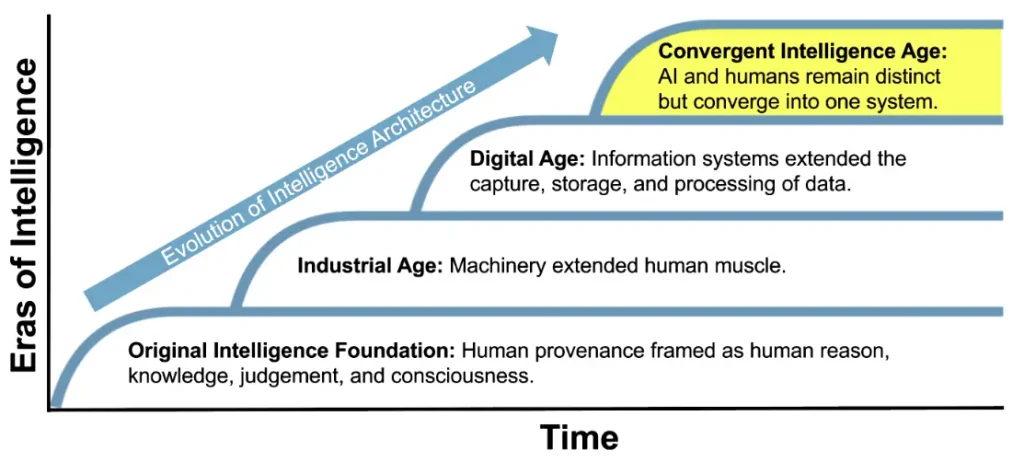
Philosophers (Plato, Aristotle, Descartes, and many others) have long examined original intelligence framed as human reason, knowledge, judgment, and consciousness. Original intelligence is not a new name for IQ. Later researchers sought to measure aspects of cognitive intelligence, with additional understanding of emotion, creativity, relationships, and practical wisdom. Original intelligence as a foundation, identifies human provenance, the intelligence from which future machine/human combinations were conceived and developed.
Many have spent decades teaching machines to imitate human intelligence, but what if the greater opportunity is to amplify the original intelligence that created the machines? In other words, original intelligence quickly coupled with technology. In the industrial age, machinery extended human muscle. Factories and equipment were a new design of work, not merely faster craft tools. In the digital age, computing and information systems extended the capture, storage, and processing of data. Hardware, software, and mindware changed how people accessed and used information.
These past eras offer lessons about adaptation, value creation, complementarity, reinvention, and changing capabilities. For example, in 1950, Alan Turing proposed the imitation game as a practical way to reframe the question, “Can machines think?” The test concerned what a machine could convincingly do in an exchange, rather than establishing the origin of its intelligence. His idea was a foundational contribution to the historical discussion.
These important previous ages showed that technology can imitate a person’s language, appearance, or behavior without thereby possessing the originating intelligence, lived experience, values, or judgement of that individual.
Moving Ahead
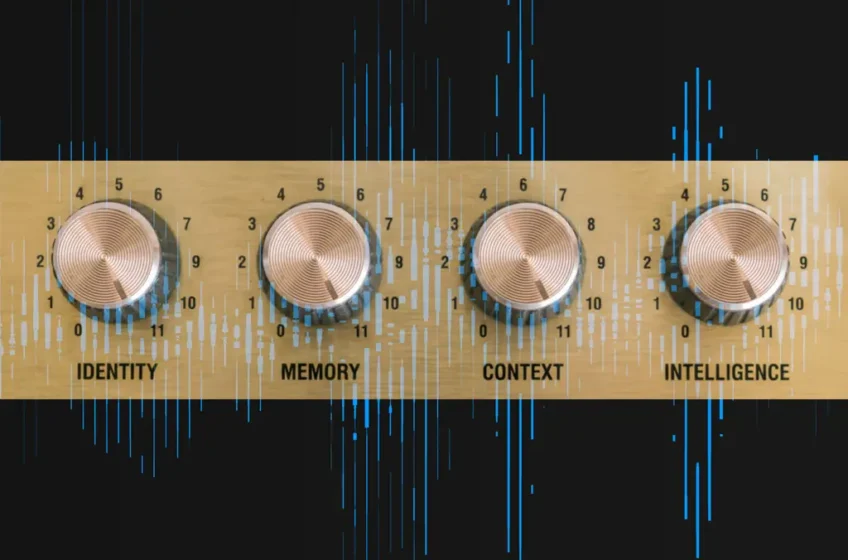
In today’s emerging convergent intelligence age, AI can detect patterns, generate content, and increasingly take action. This may mean that AI changes the productive system in a more fundamental way. For example, in the Bloor architectural framing, a human digital twin begins with the individual’s original intelligence, identity, memory, and context. An AI=generated human imitation begins with a model designed to simulate aspects of a person. The same technologies may be involved for convergent intelligence; the architectural starting point is different though. Essay 2 will examine that distinction fully.
These four waves of intelligence are captured in figure 1, each building on the foundation of original intelligence that continues to evolve.
Insights from Convergent Intelligence Architecture
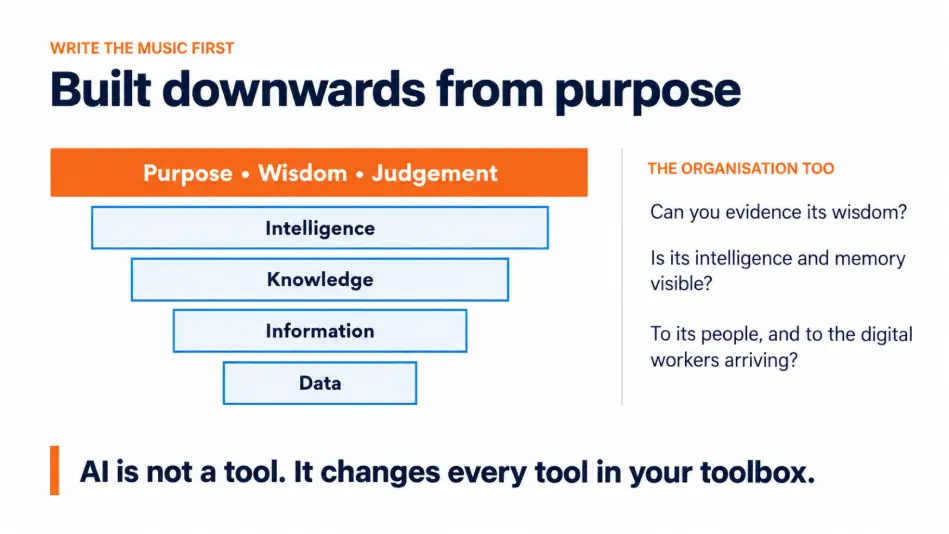
Evolving to convergent intelligence (sometimes called augmentation, centaur, collaborative, cyborg, hybrid, symbiosis) creates the potential to amplify original intelligence and expand productive capacity. A conventional computing journey (digital age) has often been described as moving upwards from data to information, knowledge, and intelligence. But more data does not automatically create reliable judgement. Incomplete context, weak provenance, or inconsistent information can undermine AI outputs, while model-generated errors can arise even when records are sound.
The alternative design with convergent intelligence starts from purpose, wisdom, and judgement, then continues downward through intelligence, knowledge, and information to the data required. This process is not a rejection of data. Rather, it asks whose intelligence directs the work and what outcome the entire architecture is intended to serve (figure 2). It raises the question: “How can an organization evidence and preserve its accumulated wisdom, intelligence, and knowledge, and make it all available to both its people and digital workers?”
In addition, convergent intelligence goes beyond augmentation that makes tasks faster to amplification that asks whether people can increase the scale and value of what they create. Capacity enhances and leads to capability, can knowledge, context, and prior reasoning remain available to deliver stakeholder value when the person is not working? This helps redefine the time constraint for traditional intelligence since the amplified tasks can be accomplished without personal involvement.
Convergent intelligence helps leaders with not only what employees produce using AI, but also what they learn, what is retained, who directs the intelligence, and who participates in the value created. Thus convergent intelligence architecture is not just an augmented productivity or capacity tool with polished reports but a new intelligence architecture that changes work.
Transformation Lessons and Implications
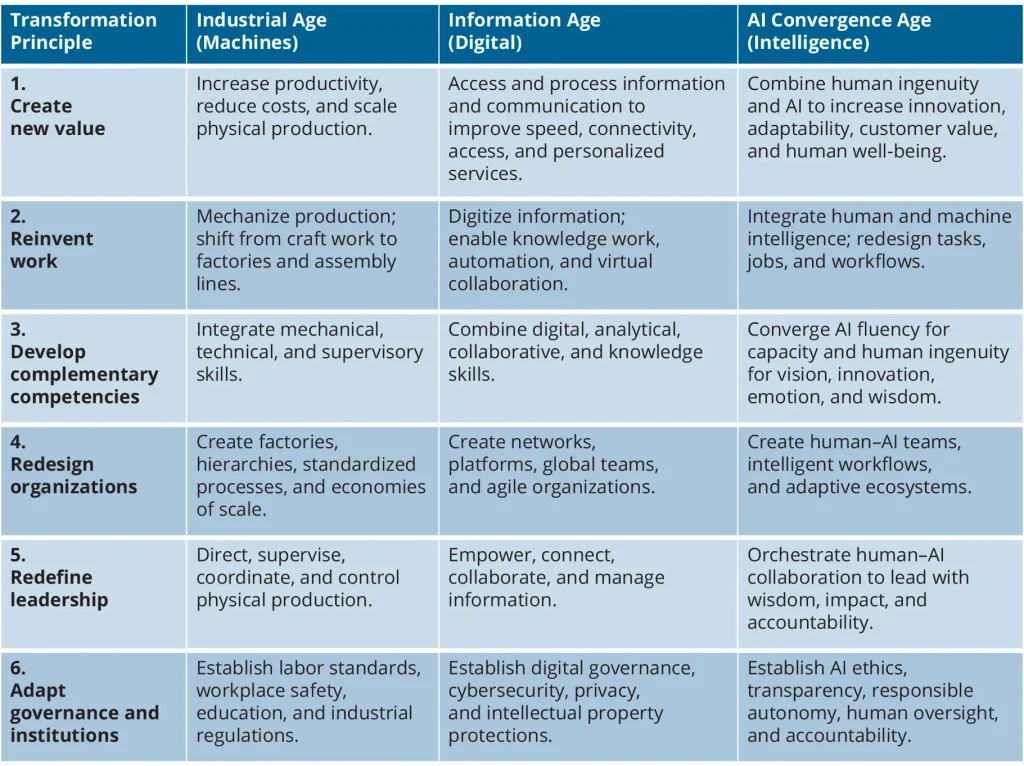
Each of these three ages follows similar transformation principles that melds technology and humanity. Figure 3 shows how six transformation principles apply and evolve in each of the three ages.
| Transformation Principle | Industrial Age (Machines) | Information Age (Digital) | AI Convergence Age (Intelligence) |
| Create new value | Increase productivity, reduce costs, and scale physical production. | Access and process information and communication to improve speed, connectivity, access, and personalized services. | Combine human ingenuity and AI to increase innovation, adaptability, customer value, and human well-being. |
| 2. Reinvent work | Mechanize production; shift from craft work to factories and assembly lines. | Digitize information; enable knowledge work, automation, and virtual collaboration. | Integrate human and machine intelligence; redesign tasks, jobs, and workflows. |
| 3. Develop complementary competencies | Integrate mechanical, technical, and supervisory skills. | Combine digital, analytical, collaborative, and knowledge skills. | Converge AI fluency for capacity and human ingenuity for vision, innovation, emotion, and wisdom. |
| 4. Redesign organizations | Create factories, hierarchies, standardized processes, and economies of scale. | Create networks, platforms, global teams, and agile organizations. | Create human–AI teams, intelligent workflows, and adaptive ecosystems. |
| 5. Redefine leadership | Direct, supervise, coordinate, and control physical production. | Empower, connect, collaborate, and manage information. | Orchestrate human–AI collaboration to lead with wisdom, impact, and accountability. |
| 6. Adapt governance and institutions | Establish labor standards, workplace safety, education, and industrial regulations. | Establish digital governance, cybersecurity, privacy, and intellectual property protections. | Establish AI ethics, transparency, responsible autonomy, human oversight, and accountability. |
These six transformation principles remain remarkably consistent. Technology creates new sources of value, changes work, requires new skills, reshapes organizations, and challenges leadership and governance. In each age, technology alone does not ensure progress. Progress requires complementary investments in people, organizational capabilities, leadership, and institutional adaptation.
As a leader deploying AI, consider these six principles as a way to frame your AI investments and to evolve it to wave 4, the convergent intelligence architecture.
Further Exploration :
We have an ambitious question for this series: “How does AI create lasting value for individuals, organizations, communities, and society?”
We do not claim to have answered it in one essay. We have, however, established why history, origin, human purpose, and economic models matter. We have also identified principles that emerge from each age that leaders should be aware of moving into the convergent intelligence architecture age. We hope this brief historical overview, key principles, and introduction to convergent intelligence goes beyond AI as a quick fix set of tools to a new intellectual architecture.
If the origin and direction of intelligence are important, what architectural choices should organizations now make?
Post 2 explores augmentation, amplification, and human and machine loops. If an organization could preserve and amplify its knowledge, intelligence, and wisdom beyond the working hours of its people, what would you redesign first: the technology, the work, or the organization itself?
Post 3 explores the evolution of human capital (people) to human capability (systems) and how AI impacts the nature of work.
Post 4 offers implications for individuals, leaders, organizations, and society of this emerging convergent intelligence architecture.
Dave Ulrich
Rensis Likert Professor Emeritus, University of Michigan Partner, The RBL Group
dou@umich.edu
Print Article for this blog Download here