The overall question of this series of four posts is easy to state: “How does AI create lasting value for individuals, organizations, communities, and society?” Innumerable books, studies, reports, position papers, webinars, podcasts, and conferences offer insights and tools for progress. The basic answer is simple, but not easy to implement. AI in the Loop with the Human works best, within a convergent intelligence architecture built on amplification, putting people first and redesigning the workforce and the work. We know our views will not capture all the nuances, but in four posts, we hope to distill ideas that will help business and HR leaders make progress.
Post 1 started with original intelligence and showed that over time, technology and people have continually collaborated through an industrial, a digital, and now an AI age around six common principles. We use the term convergent intelligence to capture the AI age of connecting people and AI. Post 2 discussed how to ensure convergence by starting with a clear purpose that requires human judgement and wisdom, and using AI innovations to amplify and accomplish the purpose, often requiring both a human (person) and digital (twin) workforce.
In this post (3), we translate convergent intelligence into actionable insights that guide business and HR decisions. We propose three steps to advance convergent intelligence into an architecture of lasting value: create unity of purpose, amplify human capability, and establish clarity of accountability.
Post 4 shares broader implications and evolving questions for individuals, organizations, communities, and society.
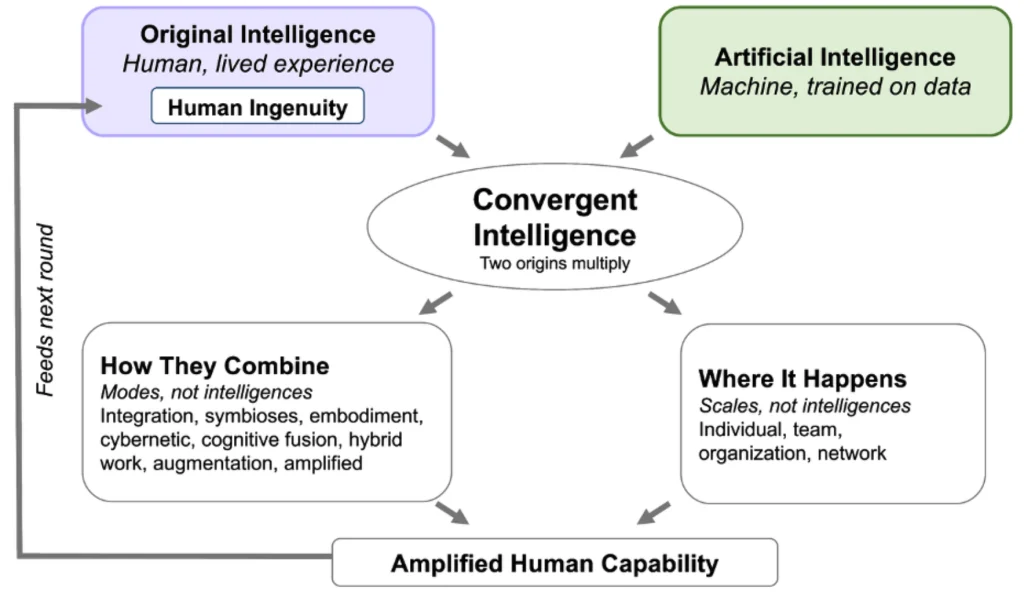
Turning ideas into impact is much easier said than done. Volumes have been written over decades about making and sustaining change. Today, the AI agenda has permeated all aspects of work, particularly the combination of people and technology. We have traced the historical evolution of original intelligence to what we call convergent intelligence (a combination of human and AI), which is a distillation of many related concepts (see figure 1 and previous posts).
Building on this material, we propose three steps to make convergent intelligence happen effectively: 1. create unity of purpose, 2. amplify human capability, and 3. establish clarity of accountability.
A. Create Unity of Purpose
Measuring activities more than results is easy and common. In HR, activity measures might include percent of employees who receive 40 hours of training a year, annual performance reviews, or engagement surveys. Likewise in AI, activity measures pervade: number of AI users, prompts, licenses purchased, or automated tasks. Activities matter, but convergence starts with unity of purpose around value created.
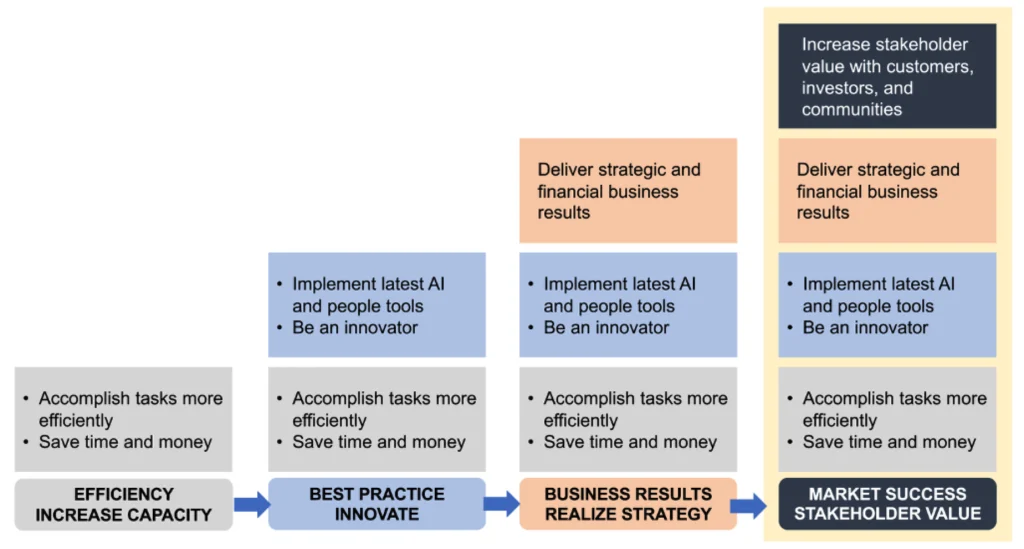
Drawing on Dave’s work in HR value creation, convergent intelligence has four outcomes (figure 2). Most of the current work on convergence starts with efficiency by removing or automating tasks to increase capacity and productivity and decrease costs. Companies then want to ensure that they are using the latest and most current tools for both technology and people. This convergent work should help deliver business financial and strategic results. We agree with all three of these organization purposes, but we also propose the next agenda, which is to deliver value to customer, investor, and community stakeholders. If an organization does not succeed in the marketplace, they no longer have a workplace; so the emerging purpose of convergence is marketplace success (figure 2). Moving to stakeholder value means that all business leaders engaged on convergence build a line of sight to how their work will deliver market value.
B. Amplify Human Capability
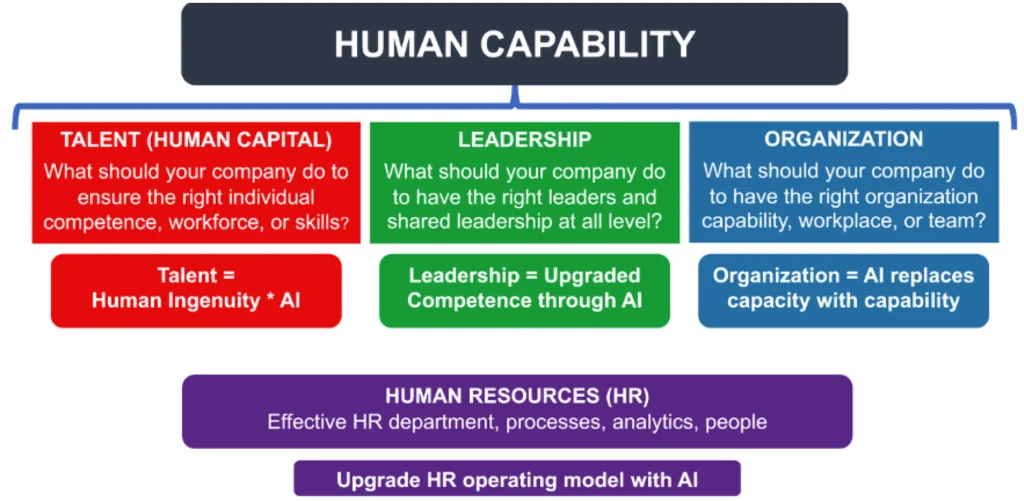
Almost all of the work on the convergence of technology and people focuses on how AI augments and amplifies work done by the individual employees, or human capital. Our research (and others’) has shown that the organization system delivers more stakeholder value than focusing on the individual employee: organization capability > individual competence; system > skill; culture > event; workplace > workforce.
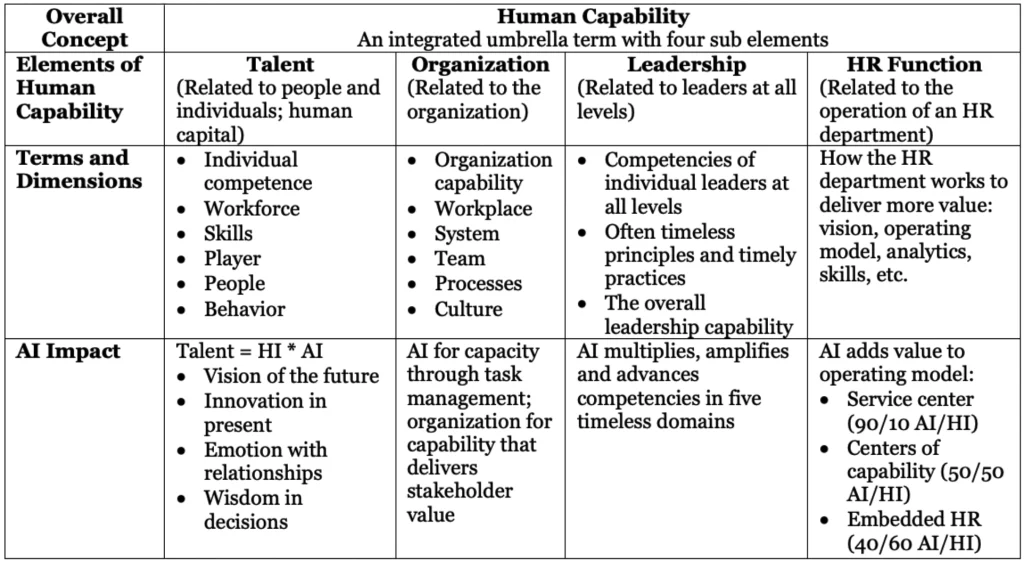
Dave has created a taxonomy that broadens human capital to human capability including talent (human capital) + organization + leadership + HR function. Each element of this taxonomy may be amplified through technology (see figure 3).
B1. Talent = Human Ingenuity * AI
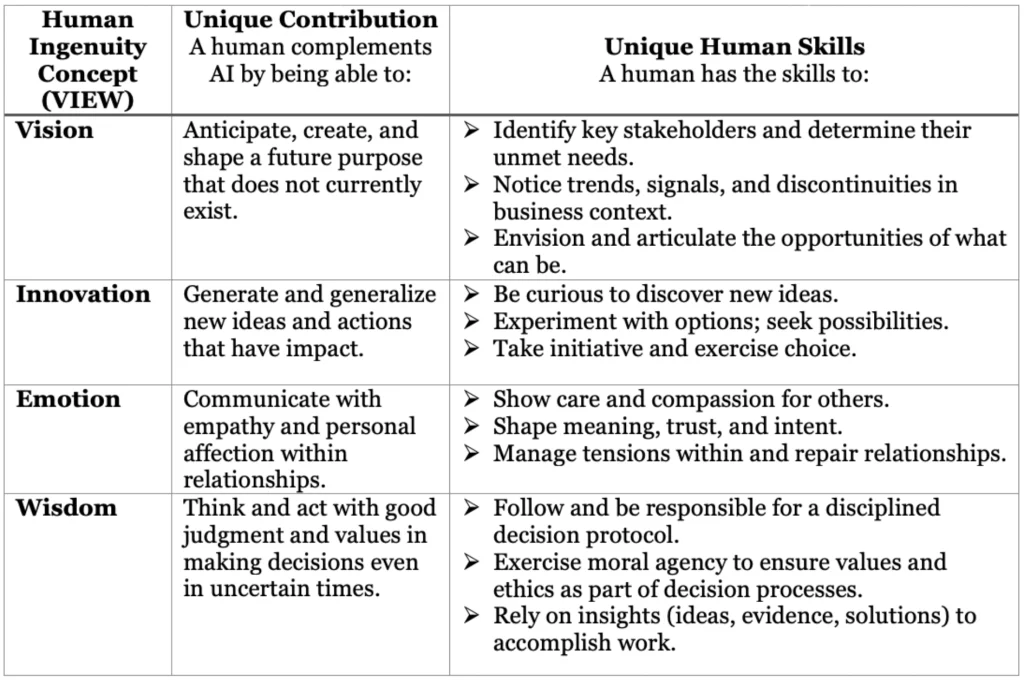
An emerging consensus is that convergent intelligence is human led and AI amplified. Humans provide critical thinking (that we have called human ingenuity, a subset of the broader concept of human capability) with four elements (figure 4).
Here is the table formatted for direct copying and pasting.
B2. Leadership: AI Ensures Upgraded Competencies
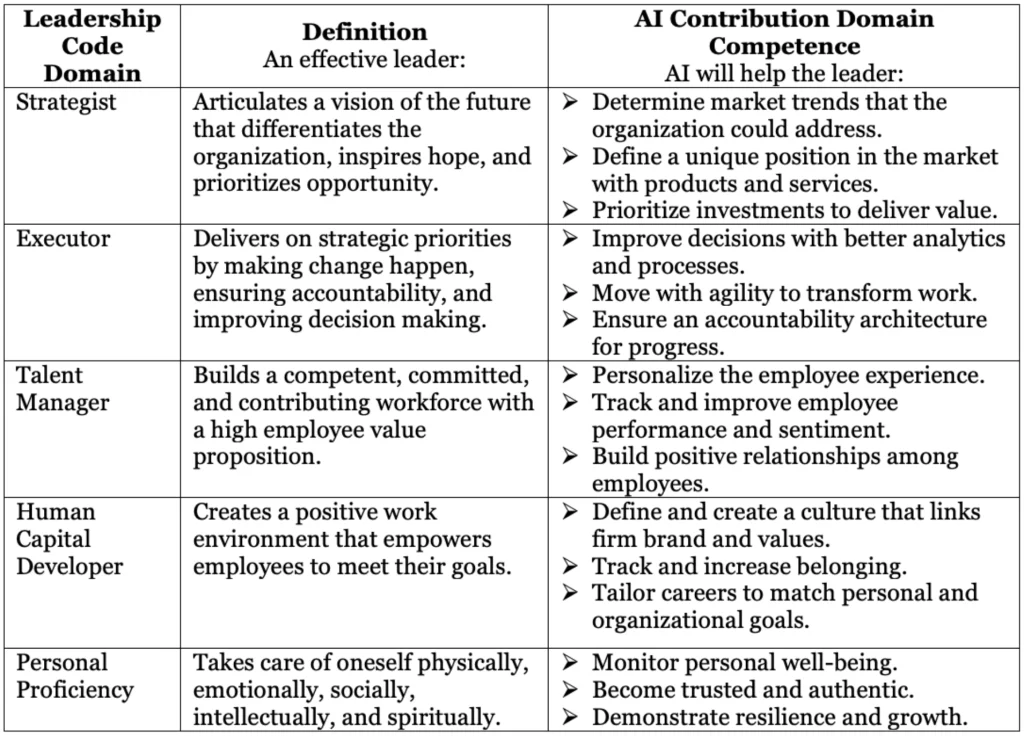
Our (and others’) research has captured the necessary competencies leaders must demonstrate to be effective in five timeless domains called The Leadership Code. Leaders can use AI to improve in each of the five domains for themselves and for those they lead (figure 5).
B3. Organization: AI Replaces Capacity with Capability
AI creates capacity by redefining and improving work tasks that results in greater productivity (lower costs, higher efficiency), less friction (time on administrative tasks), and improved quality (consistency, precision). When the excess capacity created by AI use can be turned into organization capabilities that deliver value to stakeholders, organizations prosper. Capabilities represent what the organization is known for and good at doing (e.g., agility [speed, transformation, change], culture [identity, norms, expectations], customer centricity, collaboration, simplicity, or accountability). These capabilities help deliver customer share, investor intangibles, and community reputation. Business and HR leaders can do capability audits to determine where to invest to have the greatest impact from AI-generated capacity.
Digital AI provides even greater capacity with a digital twin that allows 24-hour service seven days a week. The digital twin can accomplish many work tasks both efficiently and effectively. As Richard pointed out in our previous post, the continual update of the twin ensures that it represents accurate information.
B4. Human Resources: AI Elevates the HR Operating Model
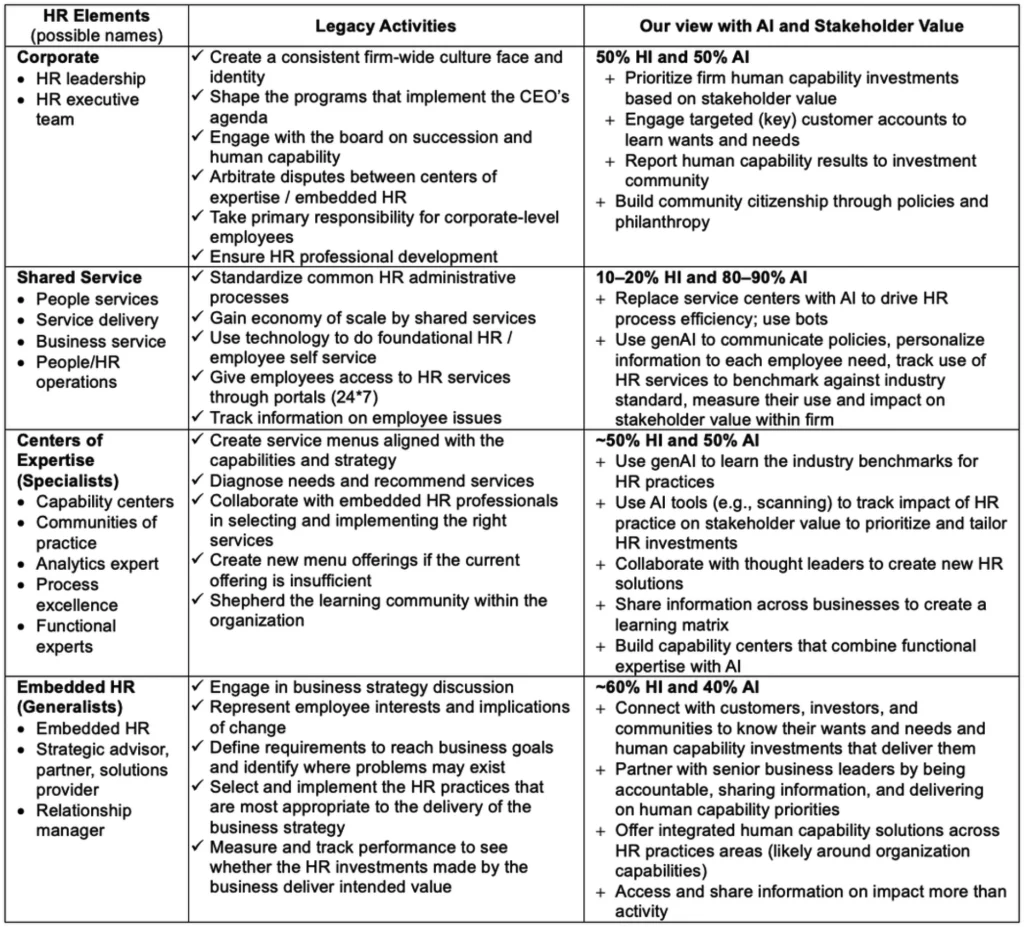
The HR function will clearly pivot its operating model with AI. Figure 6 shows how AI will evolve and elevate four fundamental elements of the HR operating model, with differing impact for each of the four elements.
Amplify Human Capability Summary
Figure 7 expands figure 3 to summarize convergence with four elements of human capability and AI.
C. Establish Clarity of Accountability
Accountability defines who is answerable for convergent intelligence by clarifying ownership and managing governance. In some cases, a single accountable individual (or function [e.g., CTO or CHRO]) can be identified. More often, to deliver the stakeholder value through human capability, an accountability architecture can be created with four decisions (figure 8).
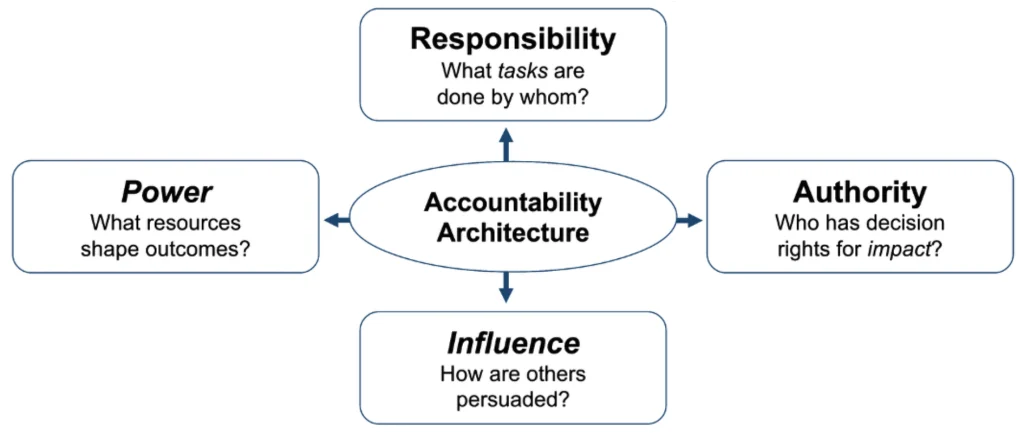
With the accountability architecture in place, individuals (and roles) and their specific responsibilities (tasks) and authority (decision rights) can be identified (figure 9).
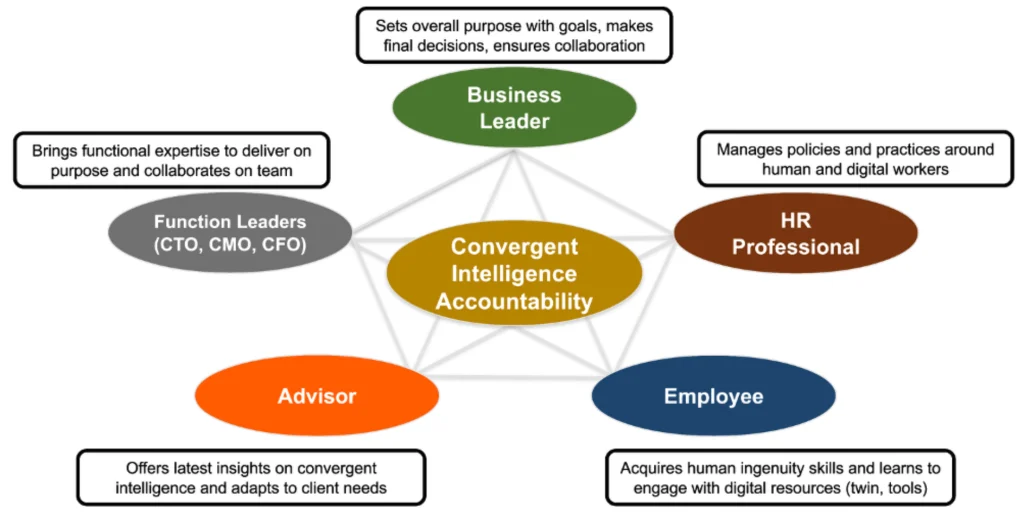
As these partners work both independently and together, they share responsibility, authority, influence, and power to deliver stakeholder HR.
Not Yet a Conclusion
No question that a convergence of human capability and AI is emerging (figure 1). This convergence starts with clarity of purpose or value created with an evolving focus on stakeholder value (figure 2). Stakeholder value broadens human capital to human capability (figure 3 and figure 7) with specific convergence activity in talent (figure 4), organization, leadership (figure 5), and HR (figure 6). Convergent stakeholder value through human capability requires an accountability architecture (figure 8) with clear responsibility and authority (figure 9).
Whew! We said the original question, “How does AI create lasting value for individuals, organizations, communities, and society?” was easy to state and answer (AI in the Loop with Human) but not easy to do. In this post, we lay out specific and simple ideas with a wide range of actions for making convergent intelligence happen effectively. In the next post, we share broader implications and next steps.
Dave Ulrich
Rensis Likert Professor Emeritus, University of Michigan Partner, The RBL Group
dou@umich.edu
Print Article for this blog Download here