PAYE, IR35, TUPE and GDPR Were All Built on the Same Assumption. Digital Labour Breaks It.
TUPE assumes work moves with people. So who does it protect when the work moves to an AI? Where UK employment law cracks, and six proposed reforms, none of them law yet
The TUPE question
Here is a question for your employment lawyer.
When a service moves from one employer to another, the Transfer of Undertakings (Protection of Employment) Regulations (TUPE) apply. The people move with the work, on their existing terms, and their rights travel with them. It is one of the better pieces of design in UK employment law.
Now move the same service to a digital system instead.
Who transfers? Whose terms are protected? Is there even a transfer at all?
There is no clean answer. TUPE assumes work is inseparable from the people who do it. The moment that stops being true, it has nothing to say.
And TUPE isn’t alone. Nearly every framework that governs UK work was built on the same assumption, and is starting to crack in the same place.
One assumption, four broken systems
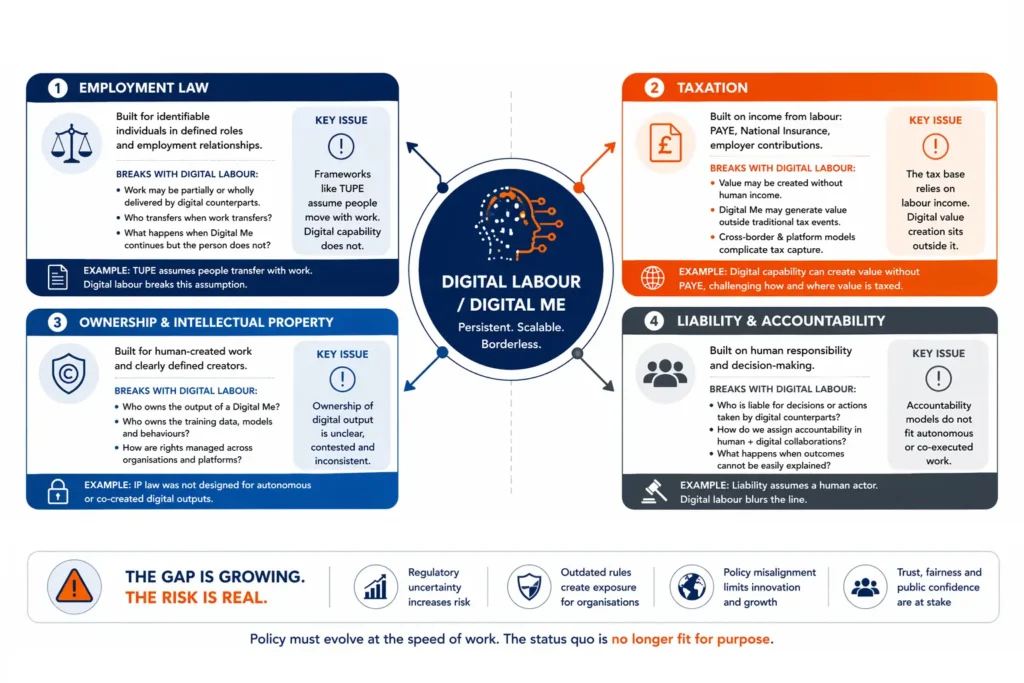
Every major system governing work in the UK rests on one proxy: value flows from human labour, delivered within defined roles, over measured time. Earlier in this series I argued that we have never actually paid for time. These frameworks were built as if we had.
- Pay As You Earn (PAYE). The UK tax system assumes most value-creating work happens inside a direct, continuous employment relationship. Fused human and digital work produces several forms of participation at once, and they don’t map neatly onto a payslip.
- IR35. The off-payroll working rules exist to stop people disguising employment as contracting. In a fusion economy, the line they rely on blurs for real. That isn’t avoidance. It is how value is now being created.
- TUPE. It assumes work moves with people. It has no answer when work moves to a system.
- The General Data Protection Regulation (GDPR). GDPR was designed for data collected about people. A Digital Me, trained on someone’s knowledge and judgement, is something else: data that works like the person. What does the right to erasure mean for a capability your organisation is still running?
Then there is intellectual property (IP). IP law defaults ownership of captured capability to the firm. Commercially convenient. Legally untested. Ethically questionable. I’ll come back to that one later in the series.
None of these frameworks is badly drafted. They were drafted for a world in which the worker and the work were the same thing.
Put them side by side and the pattern is hard to miss. An organisation can move a whole service onto a digital system with no transfer under TUPE, no clear duty to consult beyond any redundancies, and nothing on a PAYE return to show the work still exists. Every individual step can be lawful. The overall result is something no part of the system was designed to see.
Why this cracks now
Employment law has absorbed new technology before. Spreadsheets didn’t break TUPE. Email didn’t break PAYE.
The difference this time is that the technology doesn’t sit beside the worker. It does the work. And agentic Artificial Intelligence (AI) does it across whole workflows, not single tasks.
The money shows it first. Since April 2025, employers have paid National Insurance (NI) at 15% on earnings above £5,000 a year. A digital worker doing the same job generates none of it. That is the Ghost GDP problem from the last article: output that carries on while the receipts attached to it fall away.
Put simply, when work transfers between UK employers, the law protects workers and the tax revenue stays in the system. When work transfers from a UK employee to an overseas AI system, the work and the value carry on, but the protections and the revenue disappear. And the state is left funding the consequences.
A proposed reform architecture
So what would fix it?
The FusionWork™ white paper sets out a reform architecture. Before I describe it, let me be precise about its status, because this is the part most likely to be quoted out of context.
None of this is current law, and none of it has been tabled. Each element was developed from evidence submitted to the All-Party Parliamentary Group (APPG) for Modernising Employment, and each is built from precedents Parliament has already accepted. These are proposals for discussion.
They share one principle: fiscal neutrality between human and digital labour. Not a tax on technology. A system that stops caring whether the work is done by a person or a platform.
There are six proposals.
- A statutory definition of a digital displacement event, based on the economic outcome rather than the technology used. Nobody has to argue about whether a self-checkout counts as a robot.
- Mandatory Displacement Impact Assessments before an organisation buys AI that replaces roles, modelled on existing algorithmic transparency duties.
- Collective consultation extended to digital displacement events, with a defined notice period.
- TUPE reformed to recognise a Digital Service Provision Change, so the question at the top of this article finally has an answer.
- A statutory Digital Labour Authority, keeping a register of AI systems used in UK employment, on the model of the Employment Agencies Act.
- A Digital Labour Levy, charged to employers on the salary cost of displaced roles and ringfenced for a National Workforce Transition Fund, with a credit for genuine redeployment and the option to pass the cost on to vendors.
The Digital Labour Levy, costed
The levy is the proposal that gets people’s attention, so here it is in numbers.
Take an organisation that displaces 50 roles at an average salary of £32,000. That is a levy base of £1.6 million.
The white paper modelled the levy at 13.8%, the employer NI rate at the time of the research, which gives a levy of roughly £220,000 a year. Employer NI has since risen to 15%. At that rate, the same levy is £240,000.
That is an order of magnitude, not a prediction. A real scheme would need thresholds, reliefs and a workable definition of displacement.
But notice what it is not. It is not a charge for owning AI. It is roughly what you would have paid in employer NI on those roles anyway, and the redeployment credit means an organisation that moves people into new work pays less.
The precedents are familiar. The Apprenticeship Levy already charges larger employers a share of their pay bill for a ringfenced purpose. IR35 already looks through the contract to the economic reality of who supplies the labour. The levy applies both ideas to AI bought as a service.
Engagement is risk management, not compliance theatre
You may disagree with some of these proposals. Good. That is the point of putting them out for discussion.
But if you are an HR (Human Resources) Director, the gaps they describe are already your problem. When work moves to a digital system, today’s law gives you no clear answer on consultation, transfer or data rights. That uncertainty lands on your desk first: in the tribunal claim, the union negotiation, the subject access request.
It is a board conversation too. A deployment that looks clean in the business case can carry legal and reputational risk the case never priced, and the HR Director is usually the person who has to explain it afterwards.
The organisations best placed for whatever reform eventually comes will be the ones that helped shape it, and the ones already behaving as if it exists. Run the Displacement Impact Assessment now. Consult as if consultation applied. Know who owns the capability you are capturing.
PAYE, IR35, TUPE and GDPR were built for a world where the worker and the work were the same thing. Digital labour breaks that assumption. The reform debate has started, and HR should be part of it.
If you want to help pressure-test these proposals, join our policy roundtables with the APPG for Modernising Employment. The people who will live with these rules should help shape them.
This is the sixth article in a series drawn from the Bloor Research white paper FusionWork™: Defining a New Category of Work. The first asked why approximately 90% of job descriptions no longer describe the job. The fifth put a number on Ghost GDP, the tax gap digital workers leave behind.
Cheney Hamilton
Research Director – FusionWork™ Bloor Research
Print Article for this blog Download here