

K2view Test Data Generation for Workday
Update solution on August 11, 2026

K2view (named for the famously difficult-to-climb mountain) was founded in 2009, and has offices in the US, Germany, Israel, and the Netherlands. It is the developer of the K2view Data Product Platform, which originated as an ETL tool but has since grown into a widely-encompassing data management offering capable of addressing a variety of enterprise use cases. Its capabilities include data integration, data governance, data fabric, cloud migration, 360-degree customer view, test data management, sensitive data discovery, data preparation/delivery for AI, and more.

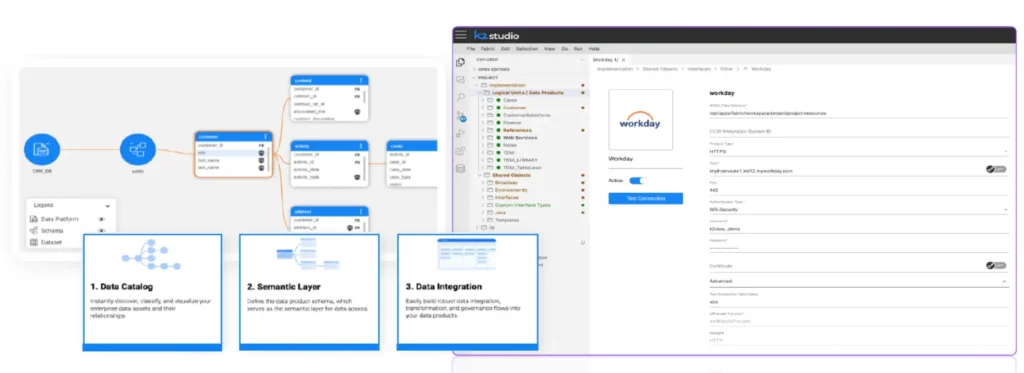
The K2view Data Product Platform offers robust test data generation capabilities for both databases (relational or otherwise) and more specialised data environments, such as the subject of this report: HCM (Human Capital Management) and Financials platform Workday. To wit, K2view can generate test data that is coherent, compliant and consistent across the Workday landscape (see Figure 1) as well as any applications or data sources that are downstream from it. This is worth highlighting due to the popularity of the Workday platform, the difficulty of populating it with valid (test) data, and the exposure risk that Workday data carries as it flows into other applications, such as payroll, finance, IAM (Identity and Access Management), and so on. Indeed, creating Workday test data will be necessary if you want to fully test any application that interfaces with it, which in turn will be necessary for truly end-to-end testing.
The core of the K2view platform is its organisation of data into business entities (such as customer, account, or policy) contained within virtualised Micro-Databases that unify all data related to each entity, across all of your systems, into a single conceptual location. This makes it significantly easier to manage your data effectively, as it allows you to operate on each entity holistically, rather than as a collection of disparate fields: relationships can always be preserved, and referential integrity can always be maintained. These entities are then used to drive K2view’s other capabilities, including the provisioning of anonymised test data sets.
When it comes to Workday, K2view allows you to create a suite of entity-derived synthetic employees using an entity model and data flows, shown in Figure 2. Due to K2view’s entity-driven methodology, these fake employees maintain referential integrity and are consistent across both Workday itself and any downstream data sources. Moreover, since Workday is time-based (and failing to respect this will result in unusable test data), K2view also ensures that temporal history is preserved.
K2view provides two primary methods for generating Workday synthetic data. First, you can leverage existing worker data (which is to say, entities) present in your production environments. As these entities will contain personal data, they will need to be anonymised across Workday and its connected systems while preserving their referential integrity. K2view provides a robust set of data masking functionality, including over a hundred prebuilt (and customisable) functions, for precisely this purpose, ultimately replacing all sensitive data with a non-sensitive equivalent. Masking rules are applied only once, at the entity level, such that each masked field resolves to the same value wherever it appears. Masked values remain contextually valid, retaining semantic consistency, and preserve key relationships, maintaining referential integrity. Masking is done in-flight, such that the newly created synthetic employees are directly “hired” into your non-production Workday instance, and can thereafter be used for testing. This process ensures that the audit log for said instance never records any real employee details, which is necessary since Workday audit logs are immutable by design. As an additional hygiene measure, before virtually hiring a new set of synthetic employees, all previously recorded employees are terminated.
While this method is effective, production data is not always available for the scenarios you need to test, and this is particularly likely for edge cases and negative tests. Hence, you may prefer the second method K2view offers. This generates entirely fictional workers using the Workday entity model (including its relationships and object hierarchy) as a template, alongside a set of rules that determine how each of its elements should be populated. For instance, a name field might pick randomly from a predetermined set of names, or it might randomly generate a string of arbitrary characters. By default, these rules are inherited from K2view’s data catalogue, which are themselves obtained (and centralised) via the platform’s broader sensitive data discovery and governance processes. They can then be customised as you like (to generate edge case or negative test data, for instance). The core advantage of this method is that it does not rely on existing data, meaning that a) it can be used even when production data is not available, and b) it is impossible to use it to reidentify any sensitive data. In addition, it allows you to entirely airgap your production and non-production Workday instances. The downside is that it will typically be slower and more laborious to set up than the previous method, although this is mitigated by the prebuilt assets K2view provides (see below).
If you are familiar with K2view’s broader test data generation capabilities, there is a notable absence here. In more advanced cases, K2view can use AI to analyse your production data, then generate synthetic data that retains its overarching statistical properties while still being entirely fake. This is not available for Workday, and deliberately so: we are told that due to the particularly stringent requirements for Workday data, this sort of probabilistic methodology cannot reliably create valid test data; conversely, deterministic, rules-based generation is more appropriate for the Workday environment.
Finally, supplementary features provided by K2view include a selection of prebuilt assets (entity models, templates, and classifications) that can be customised for your specific tenant configuration; self-service, on-demand test data provisioning without needing to wait for tenant refreshes; and integration into CI/CD pipelines (among other things) via an API.
K2view offers a robust and comprehensive solution for test data management, and its entity-driven, business-led approach is a significant differentiator that produces realistic, compliant test data. In addition, its ability to use AI to drive data classification and synthetic data generation, while not a new feature – either to the product or to the market – is certainly welcome, as is its natural language interface. It is also worth noting that K2view offers a wide range of test data management functionality – such as data discovery, masking, subsetting, and multiple kinds of synthetic data generation – within a single platform, providing an array of methods for you to pick from on a case-by-case basis without needing to incorporate additional tools.
That said, the agentic AI layer provided by Test Case Data Agent is its most standout feature. It stands to further automate test data management by removing a very significant manual step – that of interpreting and actioning the creation of the test data demanded by each individual test scenario – from the testing process, dramatically accelerating your testing efforts as a result. Moreover, with AI rapidly increasing the pace of software creation, this level of acceleration may prove necessary if you want to avoid your testing – and more specifically, your test data – from persistently delaying your overall development lifecycle.
End-to-end testing is vital for ensuring application quality and compliance, and test data is a necessary testing component. If you use Workday, you should have a way of testing applications that use it, and thus of creating test data for it. K2view is an excellent means of doing so.
Figure 1 – K2view Workday-compatible architecture
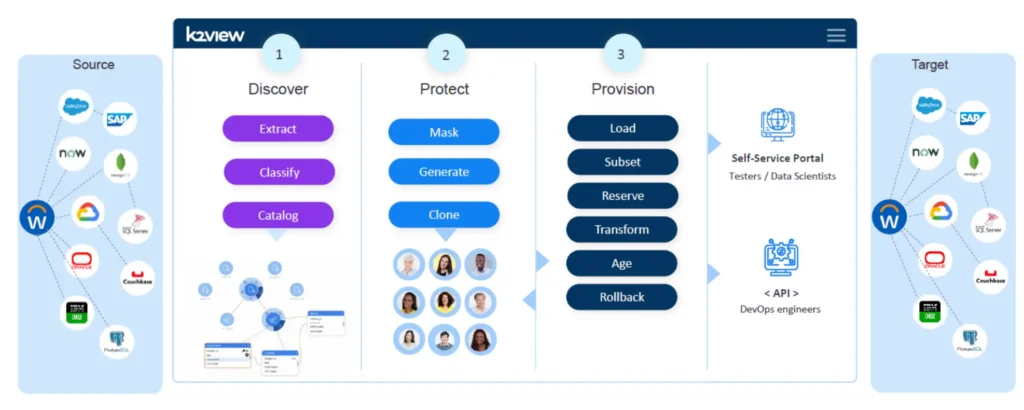
Figure 2 – Prebuilt Workday entity model and data flows
“K2view is used by a Fortune 10 retailer to eliminate real employee data from all of its non-production Workday environments, after native scrambling broke testing logic across more than 300 downstream HR systems.”
Related Company
Connect with Us
Ready to Get Started
Learn how Bloor Research can support your organization’s journey toward a smarter, more secure future."
Connect with us Join Our Community