

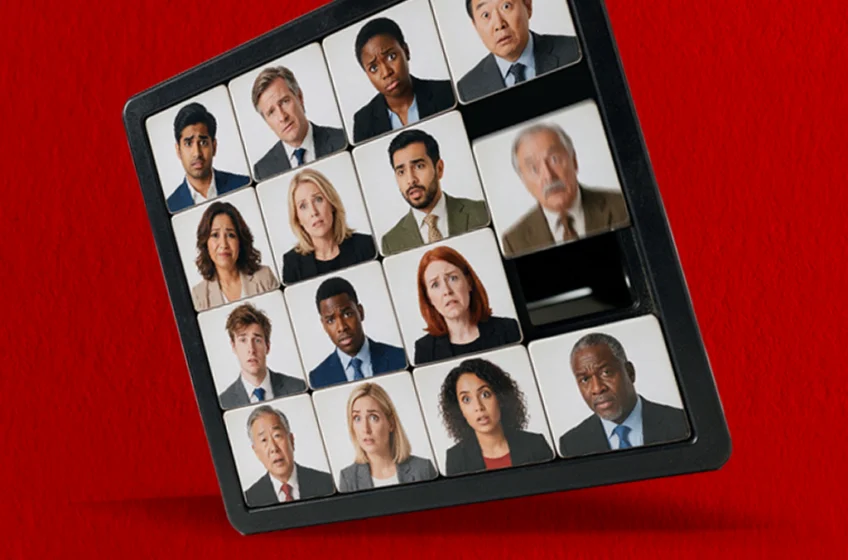
Organisational Restructuring With AI: Redesign Work First
Is your leadership team redrawing the org chart because of AI? Perhaps there is talk of fewer layers, smaller teams or a new “AI-first” structure. And underneath it, a nagging question: are we redesigning the organisation, or just removing boxes and hoping it works?
Organisational restructuring is hard at the best of times. AI makes it harder, because the work you are restructuring around is changing faster than the chart.
What is organisational restructuring?
Organisational restructuring is a deliberate change to how an organisation is set up: its layers, reporting lines, teams, departments and roles. Organisations do it to cut cost, respond to growth or decline, merge or split units, or adapt to new technology. Organisational design is the blueprint, and restructuring is the move from the current shape to the new one.
Most guides stop there and treat it as a cost exercise. AI changes the starting question. It is no longer only “where can we take out cost?” but “what does the work look like now, and what structure fits it?”
Why is AI forcing a rethink of structure?
Leaders expect big change. In a Gartner survey of senior business executives published in April 2026, 80% of respondents expected AI to force a high to medium degree of change to their operational capabilities.
The value sits in redesign, not tools. McKinsey’s 2026 State of AI survey found that nearly three quarters of the respondents it classes as AI high performers say they have fundamentally redesigned their workflows, compared with about a quarter of other respondents.
Structure is starting to follow. A McKinsey Quarterly article published in October 2026 says the test of a redesigned organisation is whether it can coordinate with fewer layers and handoffs. It also says some of the work that justified management layers will shrink, but warns that a flatter structure only works if the lost coordination is replaced by better intelligence.
In the UK, it is still early for most. The Office for National Statistics (ONS) found that, among UK businesses using AI to improve how they operate, 63% reported no change in headcount. For many organisations this is still the planning stage, which is when the structure is easiest to get right.
Why do AI restructures go wrong?
They move the boxes, not the work. Taking out a layer is easy to draw. The hard part is what that layer did: who approved, who connected teams, who knew when to escalate. If nothing replaces that, the work slows down and the structure often has to be redrawn.
They cut roles nobody has described. Much of what makes a role work is judgement, relationships and know-how that has never been written down. This is often called tacit knowledge. Bloor Research argues that knowledge, capability and capacity tell you more about a workforce than skills lists do. When the role goes, the knowledge usually goes with it, and no one notices until something breaks.They treat AI as the plan. AI is a tool that changes tasks. The plan is the outcome the organisation wants and the people, knowledge and structure needed to deliver it. Bloor argues that capability is decoupling from headcount, so the question for the board is which capabilities the organisation needs and where each should sit, not how many people AI can replace.
How should you restructure when AI is in the mix?
- Start with the work, not the chart. Map the main processes and decisions end to end. Mark where AI can take over tasks and where human judgement still decides.
- Find where the knowledge sits. Before you change any role, run a skills gap analysis that covers knowledge as well as skills, identify who holds the know-how that is not written down, and capture it while they are still in post.
- Design around outcomes. Aim for fewer handoffs, and decide explicitly what will replace the coordination any removed layer provided.
- Be clear role by role. For each affected role, decide whether it will be reshaped, retrained, redeployed or removed, and say why.
- Pilot, measure, adjust. Try the new shape in one area first. Check whether decisions got faster and whether anything important went missing.
Decisions that affect people’s jobs carry legal obligations. This post does not cover them, so take specialist employment advice on the process.
Where does Bloor’s thinking fit?
Bloor’s work on OAI℠ (Original Augmented Intelligence) starts from building intelligence into the human, not the human into the AI. In a restructure, that suggests a first move: capture what your experts know before the structure around them changes. Digital Me℠ is one way to keep that knowledge available afterwards, and Bloor explores who should own it in its analysis of the human digital twin market.
Frequently Asked Questions (FAQs)
Organisational restructuring is a deliberate change to how an organisation is set up: its layers, reporting lines, teams, departments and roles. Organisations restructure to cut cost, respond to growth or decline, merge or split units, or adapt to new technology such as AI.
Organisational design is the blueprint: how work, decisions and accountability should be arranged. Restructuring is the move from the current shape to the new one. Good restructuring starts with the design, not with the boxes that need removing.
AI changes how work gets done, and structure follows work. In a Gartner survey of senior business executives published in April 2026, 80% of respondents expected AI to force a high to medium degree of change to their operational capabilities. McKinsey’s 2026 State of AI survey found that nearly three quarters of AI high performers reported fundamentally redesigning workflows, against about a quarter of other respondents.
In some organisations it may. McKinsey argues that some of the work that justified management layers will shrink, but warns that a flatter structure only works if the lost coordination is replaced by better intelligence. Removing layers without redesigning how decisions and handoffs work is the risk.
No. Restructuring changes the shape of the organisation. Redundancy is one possible result for some roles, not the whole of the exercise. Many restructures also involve reshaping roles, retraining people and redeploying them. Any change that affects people’s jobs carries legal obligations, so take specialist employment advice before announcing anything.
Find where the know-how sits before you change the roles around it. Much of it is tacit: the judgement, exceptions and relationships that nobody has written down. Capture it from the people who hold it while they are still in post, and design the new structure so that it stays in use.
Sources
- Gartner, Gartner Survey Reveals 80% of CEOs Say Artificial Intelligence Will Force Operational Capability Overhauls, 23 April 2026. Survey of 469 CEOs and other senior business executives worldwide; fieldwork ended in Q4 2025.
- McKinsey, The State of AI: Global Survey 2026, 25 August 2026. 1,719 participants across 97 countries; fieldwork 4 May to 8 June 2026. “AI high performers” are respondents who attribute at least 5% of EBIT to AI and describe its impact as significant.
- Alexis Krivkovich, Brooke Weddle, Holly Price and Vik Sohoni, AI is changing work. Now it has to change the organization, McKinsey Quarterly, 5 October 2026.
- Office for National Statistics, Artificial intelligence in UK businesses: 2023 to 2026, 20 July 2026. Survey data from BICS Wave 159 (5 to 28 June 2026).
Print Article for this blog Download here