
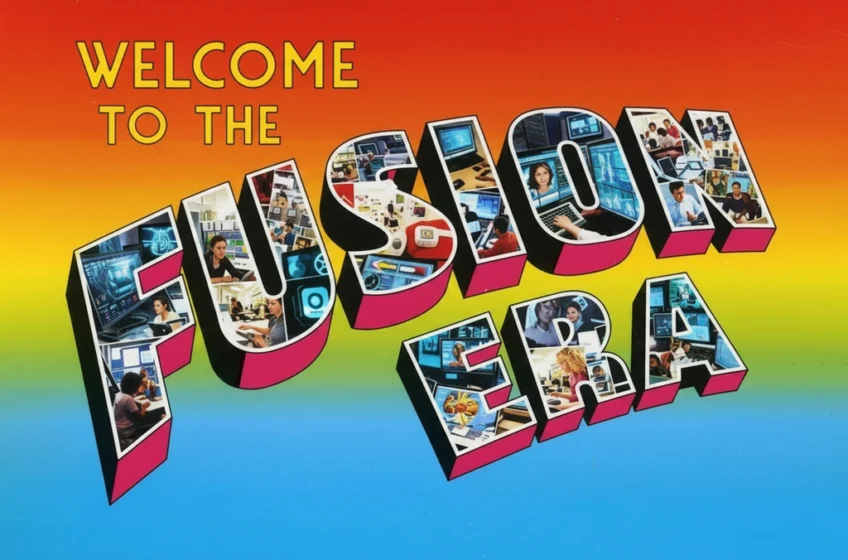
This document, “HR: Welcome to the Fusion Era,” explores the radical shift from traditional industrial-era human resource models to AI-centric “Fusion” organisations. It examines how intelligent systems are moving beyond simple digitisation to actively absorbing HR processes like recruitment screening, policy interpretation, and learning recommendations.
The text outlines a new landscape where HR’s value shifts from “owning processes” to becoming architects of human capability systems. Key themes include the transformation of decision rights into human, AI-assisted, and autonomous layers, the critical need for algorithmic governance and trust, and the evolution of workforce planning into a strategic design of human-machine collaboration. Ultimately, it challenges the HR profession to evolve quickly enough to lead this intelligence transition or risk becoming obsolete as its traditional work disappears.
Most of the HR models in use today were designed for industrial-era organisations built around human labour, hierarchical authority and slow information flows.
That world is ending. We are entering the Fusion Era, where the workforce is no longer exclusively human, and intelligence is embedded directly into systems. Decisions are increasingly informed, supported, or even executed by AI.
Software can screen candidates, analyse performance, recommend learning pathways, and interpret policy, while Agentic systems are already coordinating workflows and fulfilling tasks autonomously.
HR itself, however, remains largely occupied around processes designed for the previous century, which raises a tricky question: What is HR for when systems increasingly manage the processes HR once owned?
Let’s explore that question.
One conclusion could be simple but most likely controversial: AI-centric organisations will not need HR departments as process managers but architects of human capability systems instead.
Whether HR can evolve into that role remains an open question.
In traditional organisations, information systems record activity after decisions are made, whereas in AI‑centric organisations, intelligence is embedded inside the workflow itself and systems do not simply store information, they interpret it, analyse it and when required, act on it.
This produces three structural changes:
- Decision support becomes continuous rather than occasional.
- Workflows become algorithmically orchestrated.
- Employees interact directly with systems rather than through administrative intermediaries.
For HR this has profound implications.
Much of what HR has done over time involved managing processes for recruitment, performance, learning administration, policy interpretation and workforce reporting.
AI systems are rapidly absorbing these activities. Recruitment screening is automated, learning pathways are algorithmically recommended, compensation benchmarks are generated in real time and workforce analytics operates continuously.
In an AI‑centric organisation, the system executes the process, and the resulting implication is clear: if HR continues to define its value through owning processes, it is building its future on disappearing work.
For decades HR technology digitised HR processes without fundamentally changing them. Recruitment systems automated applicant tracking, learning systems did the same for course catalogues and performance systems replaced paper forms with digital forms, but the underlying model remained unchanged: HR owned the process.
AI now disrupts that model.
Intelligent systems now perform many of the routine tasks previously carried out by HR professionals.
Policy interpretation is handled by conversational agents, initial
recruitment screening by machine learning models and learning recommendations can be generated automatically.
These capabilities are not there to support HR; they bypass it.
The service layer hitherto belonging to HR begins to disappear as these capabilities become embedded directly into enterprise systems.
Employees and managers interact directly with the system and HR loses visibility in those activities.
That doesn’t necessarily eliminate HR, it merely eradicates HR as a process management function.
So, who actually makes Decisions now?
One key thing to understand about the consequences of AI‑centric organisations is the transformation of decision rights.
Up till now, humans made decisions and systems recorded them.
In AI‑centric organisations, systems increasingly participate in those decisions.
Three layers of decision making are now apparent:
- Human Judgement
Strategic direction, ethical choices and organisational identity remain human responsibilities requiring context, accountability and moral reasoning. AI may well inform these choices, but it does not replace them.
- AI‑Assisted Decisions
In some operations, systems generate insights while humans validate the outcome. In this category we can include recruitment screening, workforce risk alerts, compensation benchmarks and learning recommendations. The system performs the analysis, the human makes the judgement.
- Autonomous System Decisions
Some decisions can become fully automated once reliability of the process has been established. Scheduling, workflow routing and resource allocation will increasingly operate without human intervention. The system does not advise, it acts.
The Governance question
The growth of agentic systems as described above introduces a fundamental organisational challenge: these systems operate at speeds and scales that humans cannot match; without governance they may hallucinate, misinterpret data or trigger unintended actions across enterprise workflows.
The absence of governance produces risk and instability and therefore justified trust in an AI system becomes the prerequisite for adoption.
Trust requires governance, and that governance can only come from:
• clear access and control over who builds and deploys agents
• guardrails that restrict system behaviour
• decision logic audit mechanisms
• strong data governance
• the lifecycle management of AI systems
• usage cost monitoring
• continuous system oversight
Despite the growing autonomy of AI, humans remain the ultimate safeguard. Organisations should initially operate with strong oversight of intelligent systems, gradually increasing autonomy as trust develops.
The principle is simple: Trust but verify.
This transformation means that organisations need expertise in fairness, transparency, accountability and workforce ethics.
These are not engineering problems, but rather issues of governance.
If AI systems increasingly make operational decisions, the real organisational question is no longer ‘Who makes the decision?’ but ‘Who designs and governs the system that makes the decision?’
HR could reasonably lay claim to a say in the governance of workforce‑affecting algorithms both for compliance and performance reasons.
Workforce Planning: From Headcount to Capability Architecture
Traditional workforce planning was always based on people and time.
AI‑centric organisations must now plan capabilities and outcomes.
Work will be distributed between humans and intelligent systems, and tasks dynamically allocated based on capability and required result, rather than job description. The design question, therefore, instead of ‘How many employees do we need?’ becomes ‘What combination of human and machine capability produces the best outcome?’ In reality, hiring a human becomes a design decision.
Workforce planning becomes capability architecture, which is a far more strategic discipline than just headcount / FTE forecasting.
What are the implications for HR technology?
Much of existing HR technology was built to digitise HR processes rather than redesign work, for example applicant tracking, learning management and performance systems, all worked on the same premise as earlier manual systems.
AI‑centric organisations now challenge these assumptions.
Work will become increasingly organised around intelligent systems coordinating human effort, and the implications of this have consequences for the HR technology sector, as much of the current HR software has been built for a future in which HR still manages the process.
AI‑centric organisations require systems that manage the work themselves.
Developing and rolling out new technology in the middle of a product trajectory is a very expensive process, not only in execution but in marketing as well. It’s not difficult to envision some of the long-established ‘legacy’ players struggling to change course in a market that has become suddenly dynamic due to growth of single-module applications and the greater ease in linking those modules together when needed.
Regulation itself may well have a hand to play, as the legislative guardrails for the deployment and use of AI in HR tech. are still very much in their infancy in many jurisdictions.
A New Purpose for HR: from Administrator to Architect?
If HR successfully adapts to the AI transition, it will not be as a process owner, and its more likely future lies in having a role in the architecture of human capability systems viz:
- human‑AI work design
- workforce capability architecture
- decision governance
- workforce ethics and trust
- legislative compliance
This constitutes a far more strategic mandate than administering policies and procedures, although almost certainly less people than are currently engaged.
Closing Perspective – After the Intelligence Transition
Every technological transition reshapes the organisational functions that surround work; industrialisation produced personnel administration, the knowledge economy required human resource management, and the coming era will produce something different.
The function that emerges will have far less emphasis on managing employees and more focus on designing systems in which humans and intelligent machines collaborate effectively. The question is not whether such a capability will exist, but whether HR will evolve quickly enough to fully participate in it.
If you want to find out how to quickly move your HR and organisation to the Fusion Era,
Contact :
Print Article for this blog Download here